concept security aspect in category dependency injection

This is an excerpt from Manning's book Dependency Injection.
In this section, we’ll look at some examples that illustrate how to use Interception in the form of Decorators to address Cross-Cutting Concerns. From table 9.1, we’ll pick the fault tolerance, error handling, and security aspects to get a feel for implementing aspects. As is the case with many other concepts, Interception can be easy to understand in the abstract, but the devil is in the details. It takes exposure to properly absorb the technique, and that’s why this section shows three examples. When we’re done with these, you should have a clearer picture of what Interception is and how you can apply it. Because you already saw an introductory example in section 9.1.2, we’ll take a look at a more complex example to illustrate how Interception can be used with arbitrarily complex logic.
Likewise, you can use this information for performance monitoring in the same way, where you store an additional timespan next to the time and the operation details. This easily allows you to monitor which operations become slower over time. Before showing you an example of the new Composition Root with
AuditingCommandServiceDecorator<TCommand>applied, we’ll first take a look at how you can use passive attributes to implement a security aspect.
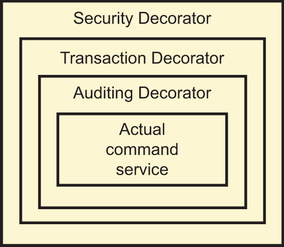
Figure 10.4 Enriching a real command service with auditing, transaction, and security aspects