concept system in category dependency injection
This is an excerpt from Manning's book Dependency Injection.
The advantage of loose coupling is the same in software design as it is in the physical socket and plug model: Once the infrastructure is in place, it can be used by anyone and adapted to changing needs and unforeseen requirements without requiring large changes to the application code base and infrastructure. This means that ideally, a new requirement should only necessitate the addition of a new class, with no changes to other already-existing classes of the system.
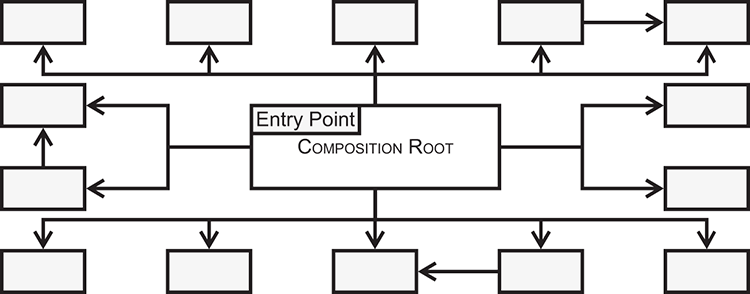
Figure 4.1 Close to the application’s entry point, the Composition Root takes care of composing object graphs of loosely coupled classes. The Composition Root takes a direct dependency on all modules in the system.
Listing 5.10 An
ITimeProviderAbstractionpublic interface ITimeProvider { DateTime Now { get; } #1 } #1 Allows consumers to acquire the system’s current time
Sticking with our auditing example from chapter 9, we’ve already established that you don’t want to put the auditing code inside the
SqlProductRepositoryimplementation, because that would violate the Single Responsibility Principle (SRP). But neither do you want to have dozens of auditing Decorators for each Repository Abstraction in the system. This would also cause severe code duplication and, likely, sweeping changes, which is an Open/Closed Principle (OCP) violation. Instead, you want to declaratively state that you want to apply the auditing aspect to a certain set of methods of all Repository Abstractions in the system and implement this auditing aspect once.

This is an excerpt from Manning's book Dependency Injection: Design Patterns Using Spring and Guice.
Not only can you describe an object graph as a system of discrete services and clients, but you also begin to see that a client cannot function without its services. In other words, an object cannot function properly without its dependencies.
These qualities of a module are largely important in relation to its collaborators. Many modules interacting with one another through established, patent boundaries form a healthy application. Since modules may be contributed by several different parties (perhaps different teams, sister projects, or even external vendors), it’s crucial that they follow these principles. Swapping in replacement modules, for example, replacing persistence in a database with a module that provides persistence in a data cluster or replacing a web presentation module with a desktop GUI, ought to be possible with a minimum of fuss. So long as the overall purpose of the application is maintained, a system of well-designed modules is tolerant to change. Much as different incarnations of an object graph provide variant implementations of a service, different assemblies of modules provide different application semantics. A module is thus an independent, atomic unit of reuse.
So far we’ve shown how to test individual units and assert their behavior. This ought to be the first step in any development process. We’ve also lain down reasons for keeping tests independent of an injector or other environment-specific concerns. As your code matures, and the time arrives for a completed module to be integrated into the larger system, new testing concerns arise. These concerns have to do with the interoperation of modules, their dependence on external factors like hardware or database resources, and the overall coherence of the system. Automated tests can help in this regard too, and this flavor of tests is called integration tests.