concept commitment in category design

This is an excerpt from Manning's book Design for the Mind: Seven Psychological Principles of Persuasive Design.
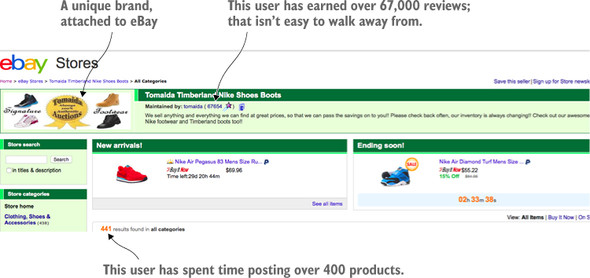
eBay accounts for the escalation of commitment through the need to create an account for both buyers and sellers. Setting up an account is perhaps the most important thing for a user to do on eBay. Users with an account can track items and stores of interest, bid, sell items, save payment options, and save shipping information. eBay allows users who sell numerous items to create a store (figure 3.15). All of these users’ customers know to find them on eBay; there would be a drastic cost to moving to another platform. The time these users spend uploading photos, creating product descriptions, and soliciting customers on eBay’s platform would be a huge consideration against changing to another platform.
People have a desire to remain consistent in their behaviors. Commitment and consistency is the underlying logic when people say, “My word is my bond.” Your friend, for example, might agree to help you move three months before you’re scheduled to move. The day before you’re scheduled to move, another friend might ask this person to go to the movies on the day of your move. Your friend is more likely to decline the invitation to the movie, even though it sounds like more fun than helping you move, in order to remain consistent with the commitment he’s already made to you.
LinkedIn creates an environment that facilitates commitment and consistency from users. Building a profile in LinkedIn is a time-consuming task. Users don’t want to waste their time, so once they’ve built a profile it’s more likely they’ll keep it up to date. A LinkedIn profile serves as a living document recording users’ professional accomplishments—this means users will want to consistently update their profile as they achieve milestones.
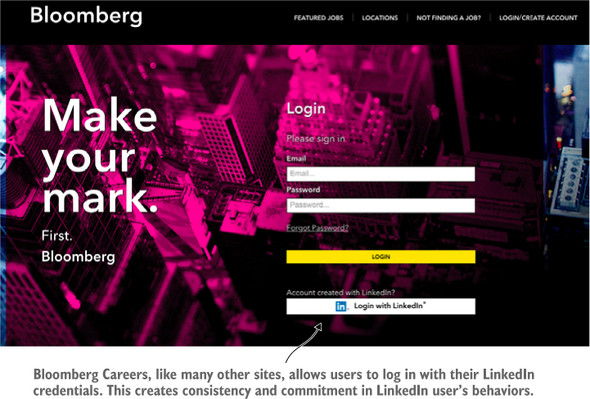
LinkedIn also fosters commitment, allowing users to log in to other sites (for example, Bloomberg Careers, figure 5.18) through their LinkedIn profile credentials. Users logging in through their LinkedIn profile have created a deeper commitment to LinkedIn as it now serves as their means for accessing additional content through other products.
You create commitment and consistency when you show users how use of your product is in line with their beliefs. Commitment and consistency manifests itself as customer loyalty in the way we see Mac users using only Apple products.
Juanita has been using Adobe products (figure 5.7) for her creative and design needs since she was in high school. She feels a strong sense of loyalty to Adobe and recommends their products to her designer friends. She has also contributed to forums on how to use advanced features on Adobe programs she uses regularly. Using anything else just feels wrong. Juanita immediately downloads newly released or updated Adobe products without question, demonstrating commitment and consistency in her behavior. She’s also displaying behavior consistent with the escalation of commitment heuristic (section 3.3.6), in which she’s avoiding the cost of learning new software from another company.