concept compliance in category design

This is an excerpt from Manning's book Design for the Mind: Seven Psychological Principles of Persuasive Design.
Compliance —Individuals will agree with the attitudes of others in public but state differing opinions in private. In one study, Kelman presented 7th-grade students with a message about comic books that conflicted with the view they held (groups of students stating they liked comic books received a message that reading comic books was bad). Participants then wrote a brief essay stating their view on reading comics. An instructor encouraged one group of participants to conform with the view of the conflicting message they’d received. The other group didn’t receive such coaching. The group that received encouragement to conform wrote more essays agreeing with the conflicting view, but fewer of those participants expressed a true change of attitude toward comic book reading when asked privately.
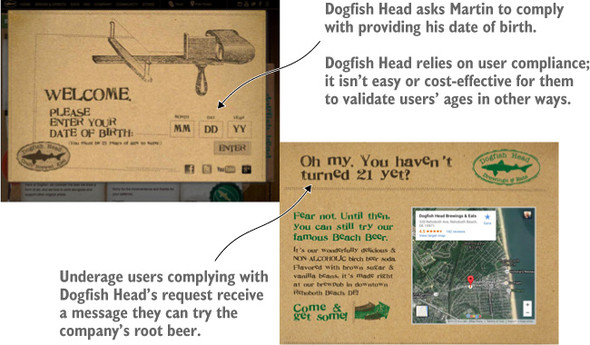
Martin is 19 years old and looking for more information on local beers. He navigates to the Dogfish Head Brewery website to see which seasonal beers they’re brewing. Martin immediately encounters a modal warning him that all visitors need to be 21 and asking him to enter his date of birth. Although no one is around to force him to be honest, Martin enters his correct birthday because he believes that’s what he should do. He then receives a message informing him he isn’t old enough to enter the website (figure 6.4). Martin demonstrated compliance with Dogfish Head’s request that he enter his correct birthday.
Figure 6.4. Dogfish Head and other American breweries ask users to comply with a request for verifying users’ ages prior to granting them access to their website.
Compliance is when people agree to do something they’re asked to do, because they realize the person or persons asking them have an expectation that they’ll engage in the behavior. Often, people in authority can gain compliance from others. Decision makers must accurately interpret the desires of those making the order for compliance to effectively make their decision. You can’t comply correctly with something you don’t understand correctly.
Peer pressure to consume drugs or alcohol is a negative example of compliance. Someone taking time for daily exercise because their friends ask them to meet at the gym is a positive example of compliance. One key piece to compliance is that you actually ask someone to engage in the task; compliance doesn’t rely on passive attempts to influence behavior.
Compliance has a negative connotation. People don’t want to be pushed around or told what to do by overbearing salespeople. You can design for compliance in a way that enhances your users’ experience.
Compliance is about how you ask your users to do something. To get our users to comply with what we’re asking, we need to be straightforward about what we want them to do. If you want your users to purchase or use your product, you should be direct in how you ask. Users will respect you for that. You shouldn’t attempt to force people by using veiled threats or use any type of buried text that most users overlook. For example, Hertz car rental (figure 6.10) forces users to sign up for its marketing emails if they want to have their car rental confirmation emailed. If you expect your users to appreciate gaining compliance through this type of manipulation, you’re wrong. I’ll unsubscribe to the next email I receive from Hertz.