concept influence in category design

This is an excerpt from Manning's book Design for the Mind: Seven Psychological Principles of Persuasive Design.
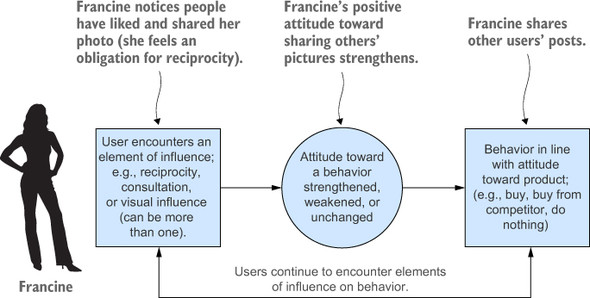
Francine watches birds as one of her hobbies. One day, she sees a rarely sighted bird as she’s walking to her car after work. She whips out her smartphone and takes a perfect picture of the bird as it’s in flight. She then posts the picture to Instagram so all her birder friends can see what she came across. When Francine arrives home, she sees that a number of people have liked and shared her picture. Some of them she has never even met. Francine feels proud of her picture and feels like she wants to express her appreciation to everyone who shared her photo. She logs in to Instagram and finds a photo to share from each person who shared her photo; even people she never met before, even photos she isn’t really that interested in sharing. Francine has just engaged in reciprocity: she received something and then felt obligated to do something in return, one of the key concepts of the principle of influence.
This chapter will introduce the principle of influence to kick off our discussion on influence and persuasion. Influence (figure 5.1) taps into our ability to shape the attitudes and behaviors of others toward our product. We see influence at work in our everyday lives, from how we convince our peers to work with us, to what products we purchase, to what websites and applications we use. Everything we encounter has the potential to influence us.
Figure 5.1. Individuals encounter an element of influence that positively or negatively impacts their attitude or leaves it unchanged. Individuals then engage in a behavior in line with the attitude. The process happens repeatedly as we come across elements of influence throughout our daily life.
You must proactively address influence in your designs, or you’ll lose users to other more influential designs. Fortunately, the opposite is true as well. You gain users when you effectively incorporate influence in your design.
Since the day we are born, other people influence us. Our parents or caregiver influenced what we ate and drank, whom we visited, and where we lived. Our exposure to other people through school or activities led to additional encounters with influence. We often credit salespeople who are influential with being good at sales. In reality, sometimes we’re subjected to influence because we don’t care to do the work of forming an opinion about something ourselves, and sometimes it’s because someone or something is effectively using the principle of influence. Your design needs to account for influencing users in either one of these mind-sets.
Most of us are also attempting to influence others on a daily basis. We wanted to influence our employer or client to hire us, we want to influence our children to clean their bedrooms, and we want to influence our talented colleagues to work with us on a difficult project. I want to influence you to read this book and recommend it to others. Influence is an important part of all our lives.