concept loss in category design

This is an excerpt from Manning's book Design for the Mind: Seven Psychological Principles of Persuasive Design.
People experience loss when they feel like they have less of something than what they started with. Loss is not just financial: time, effort, and other resources can be lost. You can use loss aversion as a blueprint for good design. You address loss aversion when you make sure your design is usable and convenient. You can’t altogether avoid loss; you want users to spend time on your site completing a profile, searching for goods, or selecting a product. Be strategic about how you introduce losses to your users, and follow up with perceptions of a gain or multiple gains since they’ll feel the pain from a loss stronger than a gain. You might ask people to complete a profile (loss of time) so that they can receive customized recommendations (gain back time in the long run) and save their billing information for reuse (gain back time in the long run), and gain access to additional information on your site (gain in resources/knowledge).
People make decisions that lead to behavior: they decide either to do something or not do it. Outcomes are attached to each behavior, and people attach a positive or negative outcome to the decision made. If someone uses your website to purchase shoes and the wrong pair is shipped, that person will assign a negative outcome to use of your website. People assign different values to the potential outcomes that exist for a decision. Individuals consider a number of possibilities when assigning weight, starting with whether they view the outcome as a gain or loss—more often, they view negative outcomes stronger than positive outcomes.
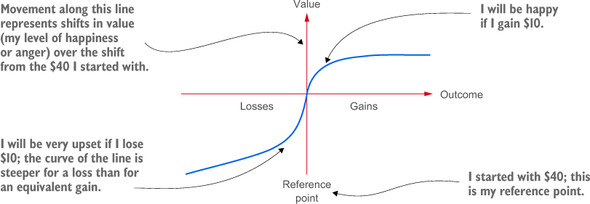
People enter a decision-making scenario with a reference point. Individuals view a potential outcome as a gain or a loss based on this reference point. If I have $40, that might be my reference point. I’d consider any decision leading to greater than $40 a gain.
Researchers have found that people assign a greater value to losses than to gains (figure 3.3). Individuals experience more pain with a loss than the amount of joy when they experience an equal gain. I’d feel fairly happy if I found $10 and now had $50 in cash. But I’d feel much more unhappiness if I lost $10 and was down to $30 in cash. This leads people to engage in loss-averse behaviors—they want to avoid feeling loss. This has a major effect on decision-making.