concept production in category docker

This is an excerpt from Manning's book Bootstrapping Microservices with Docker, Kubernetes and Terraform.
The learning curve we must endure can seem insurmountable if you tackle it by yourself, but instead, we’ll take on this development adventure together. We’ll start as simple as possible and piece-by-piece we’ll build up to deploying our application to production. This book is about cutting through the learning curve and bootstrapping a working application that we can continuously update and build on in the future. Figure 1.1 illustrates this idea of cutting through the learning curve. Although our example application will be small and simple, from the start we will build-in pathways to scalability that will later allow it to be expanded out to a truly massive distributed application.
set PORT=3000
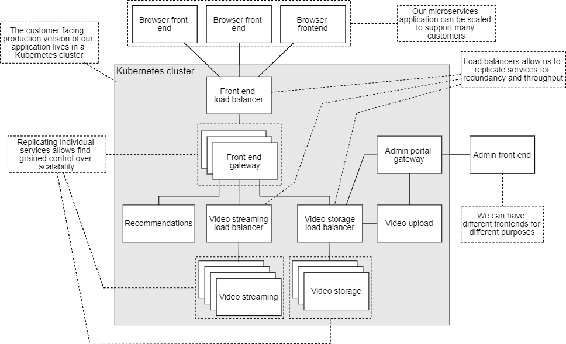
Getting to chapter 9 has been a long road to travel. Along the way we used numerous tools to build microservices, test them and deploy them to production. In this chapter we’ll see the fruits of our labor come together in the completed version of the FlixTube example application.

This is an excerpt from Manning's book Learn Docker in a Month of Lunches.
My own Docker journey started in 2014 when I was working on a project delivering APIs for Android devices. We started using Docker for development tools--source code and build servers. Then we gained confidence and started running the APIs in containers for test environments. By the end of the project, every environment was powered by Docker, including production, where we had strict requirements for availability and scale.
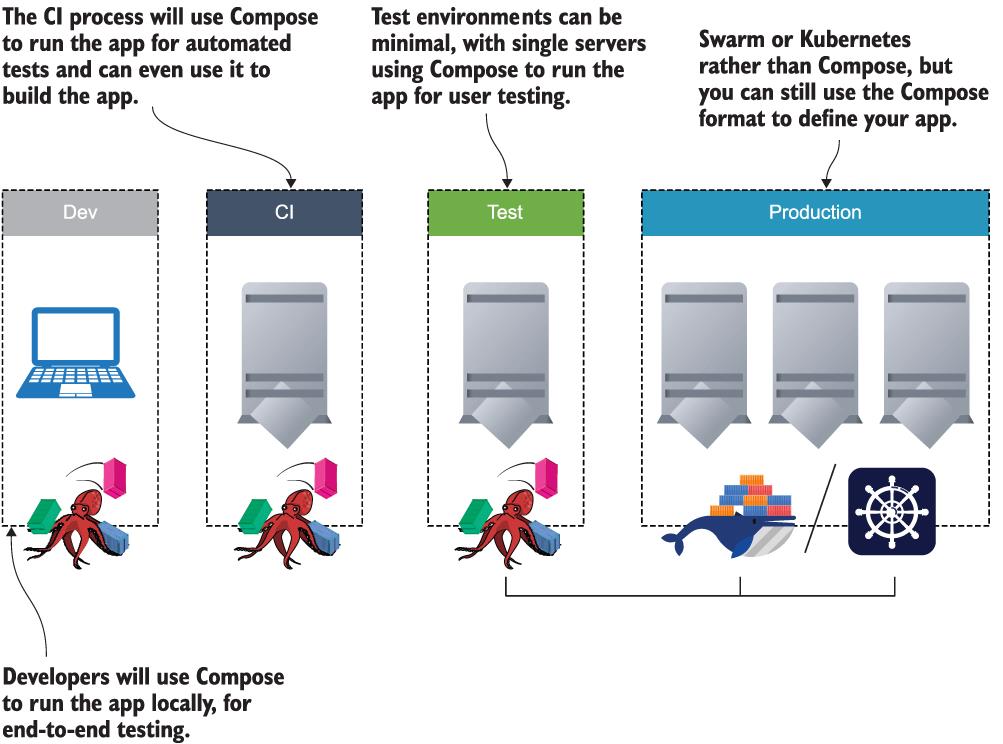
Developers can run whole application stacks on their machines with the exact same technology used in production. There’s no more wasted time tracking down missing dependencies or juggling multiple versions of software. The dev team use the same tooling as the operations team, so there’s common ownership of components.

This is an excerpt from Manning's book Docker in Practice, Second Edition.
Continuous delivery (CD) is a paradigm for software delivery based on a pipeline that rebuilds the system on every change and then delivers to production (or “live”) through an automated (or partly automated) process.
In this chapter we’re going to cover some of the subjects that come up when running in production. Running Docker in production is a big subject, and production use of Docker is still an evolving area. Many major tools are in the early stages of development and were changing as we wrote this book’s first and second editions.

This is an excerpt from Manning's book Docker in Action.
Docker containers are not the most isolated by default. Docker does not require that you enhance those defaults. It will let you do silly things in production if you want to. This makes Docker seem much more like a tool than a burden and something people generally want to use rather than feel like they have to use. For those who would rather not do silly things in production, Docker provides a simple interface to enhance container isolation.
In production, you really should include an environment validation script (see section 8.4.1) just to make sure that the containers have been linked correctly. But because you’re using an NGINX upstream directive, it will verify that the host can be resolved for you.
In production a logging configuration that’s set too sensitive can overwhelm disk or log-handling infrastructure. Dial down the log level by setting an environment variable. Set REGISTRY_LOG_LEVEL to error or warn: