concept business rule in category dsl

This is an excerpt from Manning's book DSLs in Action.
With more and more programming languages offering higher levels of abstraction design, DSLs are poised to be a major component in today’s application development ecosystem. Nonprogramming domain analysts will surely have a major role to play here. With a DSL implementation in place, they’ll be able to write test scripts correctly from day one. The idea isn’t to run the scripts immediately, but to ensure that you’ve adequately covered the possible business scenarios in your implementation. When the DSL is designed at an effective level of abstraction, it’s not unusual for domain experts to browse through source code that defines the business logic. They’ll be able to verify the business rules, and provide immediate feedback to developers based on their observations.
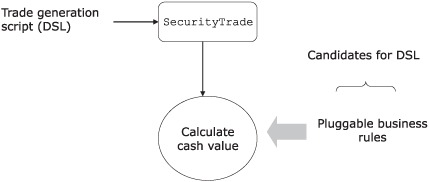
Business rules are the hotspots for using DSLs. They form the configurable sections of your domain model and are the most important things that you need to verify through your domain experts. It’s an added benefit if your DSL is friendly enough for your domain experts (like our friend Bob) to be able to write a few tests around them. For our DSL, the business rule that we need to model is that the tax and fees for a trade must be calculated. See table 6.4 for how that takes place.