concept compile - time metaprogramming in category dsl
appears as: compile-time metaprogramming

This is an excerpt from Manning's book DSLs in Action.
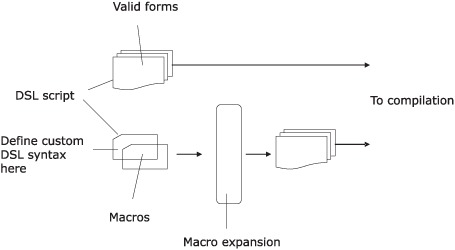
Some languages offer compile-time metaprogramming. When you’re developing a DSL using this kind of language, you build metastructures as part of your source code, which get translated to the normal forms of the language before it runs. Lisp supports this technique through macros that get expanded to normal Lisp forms during the macro expansion phase (I discuss this in more detail in appendix B). For these languages, there’s an intermediate stage where you have source code translation before the byte code is generated for the virtual machine.
Figure 2.7. You use macros to do compile-time metaprogramming. Your DSL script has some valid language forms and some custom syntax that you’ve defined. The custom syntax is in the form of macros, which get expanded during the macroexpansion phase into valid language forms. These forms are then forwarded to the compiler.
This definition has specific semantics when we talk about it in the context of different languages. Languages like Lisp offer compile-time metaprogramming, as we saw in detail in section 2.5.2. Languages like Ruby and Groovy offer runtime metaprogramming and can generate code during runtime using eval and dynamic dispatch methods. In this section, we’ll examine a specific example of how you can reduce the surface area of your DSL abstractions by writing less explicit code, instead relying on the language runtime to generate the rest for you. You might be asking yourself, why is this important?