concept domain modeling in category dsl

This is an excerpt from Manning's book DSLs in Action.
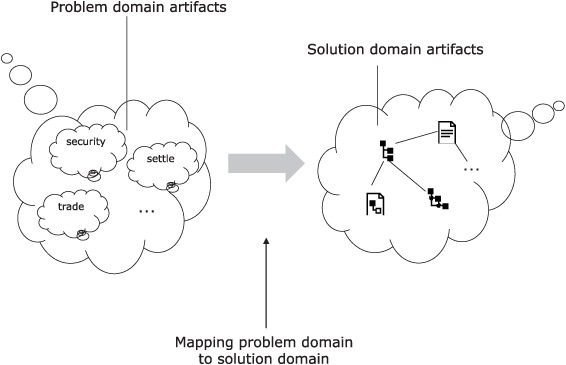
You implement a problem domain analysis model in terms of the tools and techniques offered by the solution domain. The barista could map your order to the procedure that she needed to follow to serve your Grande Skinny Cinnamon Dolce Latte. The process she followed and the tools she used formed parts of her solution domain. When you’re dealing with a larger domain, you might need more support from your solution domain in terms of the tools, methodologies, and techniques that it needs to offer. You need to map the problem domain components into appropriate solution domain techniques. If you use an object-oriented methodology as the underlying solution platform, then classes, objects, and methods form the primary artifacts of your solution domain. You can compose these artifacts to form larger ones, which might serve as better representations of higher-level components in your problem domain. Figure 1.1 illustrates this first step in domain modeling. As you move along, you’ll flesh out the process of how to get to the solution domain by using techniques that domain experts can understand throughout the lifecycle of transformation.
Figure 1.1. Entities and collaborations from the problem domain must map to appropriate artifacts in a solution domain. The entities shown on the left (security, trade, and so on) need corresponding representations on the right.
The primary exercise involved in domain modeling is mapping the problem domain to artifacts of the solution domain, so that all components, interactions, and collaborations are represented correctly and meaningfully. To do this, you first need to classify domain objects at the proper level of granularity. When you correctly classify domain objects, each object of the problem domain is visible in the solution domain, with its proper structure and semantics. But your map can be only as good as the language of interaction between the domains. A solid interaction requires that the problem domain and the solution domain share a common vocabulary.