concept feature in category dsl

This is an excerpt from Manning's book DSLs in Action.
A common vocabulary, shared between the stakeholders of the model, serves as the binding force that unifies all artifacts that are part of the implementation. More importantly, with the common vocabulary in place, you can easily follow the path of features, functions, and objects across all phases of the project delivery cycle. The same terms that the modeler uses for documenting use-cases appear as module names in programs, entity names in data models, and object names in test cases. In this way, a common vocabulary bridges the gap between the problem domain and the solution domain. Creating a common vocabulary might take more time up-front than you’re initially willing to spend, but I can almost guarantee that you’ll save yourself a lot of redoing in the long run. Let’s look at some of the tangible benefits that a common vocabulary offers.
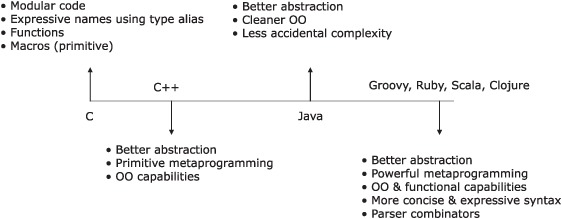
We’re going to discuss some of the areas that DSL designers are focusing on that enhance DSL-based development. Figure 9.1 shows a roadmap of the features that you’ll learn about on the last leg of our journey together.