concept parser in category dsl
This is an excerpt from Manning's book DSLs in Action.
Figure 1.6. You need to develop your own language-processing infrastructure for an external DSL. The infrastructure includes lexical analyzers, parsers, and code generators commonly found in high-level language implementations. Note that the complexities of each of them depend on how detailed your language is.
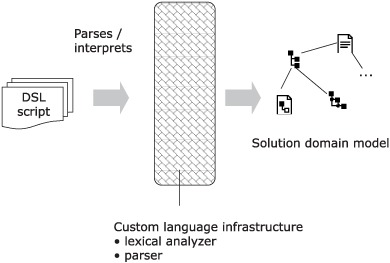
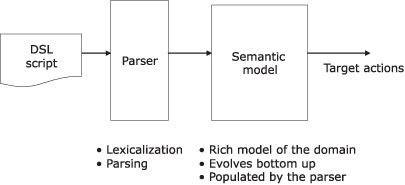
Figure 7.4. We’ve split the parsing infrastructure box of figure 7.2 into two separate abstractions. The parser takes care of the core parsing of the syntax. The semantic model is now a separate abstraction from the parsing engine. It encapsulates all the domain concerns that are ready to be fed into the machinery that generates all the target actions.
The parser that you design is an abstraction for the grammar of your language. If you choose to implement the entire parser by hand, you’d need to:
This parser adds backtracking infrastructure to an LL(k) RD parser, which gives it the power to process arbitrary-sized look-ahead sets. With backtracking infrastructure in place, the parser can parse ahead as far as it needs to. If it fails to find a match, it can rewind its input and try alternate rules. This capability makes it quite a bit more powerful than the LL(k).
OK, so it can backtrack and choose alternate rules, but is there any order to this process? You can specify hints for ordering in the form of syntactic predicates, as in ANTLR (see [2] in section 7.6). You can declaratively specify the ordering so that the parser can select the most appropriate rule to apply on the input stream.
With this kind of parser, you get much more expressive grammars, called parsing expression grammars (PEGs). PEG is a more expressive form of grammar that extends ANTLR’s backtracking and syntactic predicates (see [4] in section 7.6). PEG adds operators like & and ! that you specify within the grammar rules to implement finer controls over backtracking and parser behaviors. They also make the grammar itself way more expressive. You can develop parsers for PEGs in linear time using techniques like memorizing.