concept pattern in category dsl

This is an excerpt from Manning's book DSLs in Action.
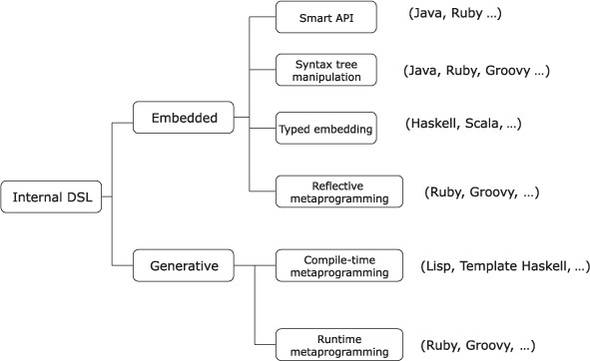
Sections 6.1 and 6.2 will establish Scala as a host for internal DSLs. After that, we get into the details of implementing real-world use cases from our domain of securities trading back-office systems. You’ll see lots of idioms, best practices, and patterns in action in sections 6.3 through 6.6. In section 6.7, we’ll discuss how you can compose multiple DSLs to evolve larger ones. We’ll conclude the chapter with a discussion about how monads can make your DSLs concise, functional, and more expressive.
Besides offering a simplified constructor invocation syntax, case classes in Scala use pattern matching over deconstructed objects, a feature typically used by algebraic data types in functional languages like Haskell. (For more information about algebraic data types, go to http://en.wikipedia.org/wiki/Algebraic_data_type. For more details about how pattern matching works in Scala, see [2] in section 6.10.) The reason for using pattern matching over case classes is to implement a generic and extensible Visitor pattern (see [3] in section 6.10).
In DSL design, you can use the same pattern to make your domain rules more explicit to users. Although with a typical OO implementation such rules tend to be buried within object hierarchies, you can use this functional paradigm over your case classes to achieve a better level of expressiveness and extensibility. For more details about how pattern matching over case classes in Scala leads to more extensible solutions compared to a traditional OO Visitor implementation, see [5] in section 6.10.