concept cloud in category edge computing

This is an excerpt from Manning's book Making Sense of Edge Computing.
In contrast, packet switching breaks data into units, which we call packets, allowing independent communications over shared links. If you have broadband Internet or a 4G or newer phone, you are making use of a packet-switched network. So, why is this important? Consider all the network devices in your home, office, or even on your person. If these devices made use of circuit-switching technology, you would have the equivalent of a physical phone line per device. Can you imagine ordering a new phone line be installed for your Internet-connected toaster and a separate line for your TV? Those involved in the early days of the Internet didn’t conceive of connecting your home lighting to a remote cloud service: the cloud didn’t exist, and there was no necessity for the average company, much less individual, to have access to generalized packet-switched networks, allowing access to and from many devices globally. So, what new computational paradigm will allow for and perhaps drive a new age of technology?
3.5 Use case: Bridging agents between home and the cloud
The world of cloud computing has opened the doors to affordably, quickly, and easily scalable computing infrastructure to the needs demanded by our applications. Entire datacenters have been migrated to large cloud providers to simplify the management of these applications and reduce the complexity of on-premises computing requirements. But for all the shake-ups that this shift has caused, there are still situations in which you need to keep some portion of your operations close to home. This could be due to a number of issues — privacy concerns, specific hardware requirements, connectivity issues, and others — but there are times in which you may need to straddle between your on-premises systems and your presence in the cloud.
Using an edge-computing framework to link agents in the cloud-provided infrastructure with agents on your local specialized machines can allow you to develop edge applications that can process the raw materials on site and then process the data in the cloud without having to manually manage any of the intermediate steps for each specific run, reducing the overall complexity of managing this processing and the time to deliver the results to the requesting clinicians and physicians.
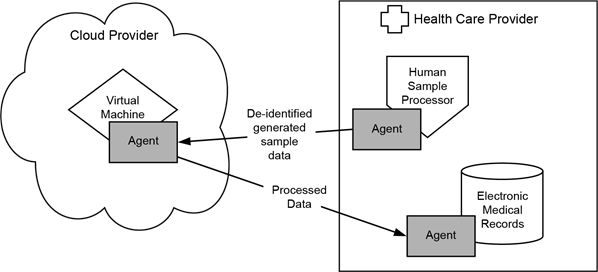
Continuing to look at the health care field, we know that privacy is of paramount concern when dealing with health matters. Mishandling or leaking private health data can result in undue harm to the individual as well as massive fines for the institution that makes the mistake. For this reason, it is important to design systems in health care to ensure that privacy is always a first-class citizen in any application. But this shouldn’t stop these institutions from making use of cloud infrastructure to process various data related to a patient. Suppose an institution needs to make a report of various tests conducted on samples related to a patient available locally for diagnosis. An edge application can be designed to de-identify the samples before they are sent to the cloud for processing, processed in the cloud concurrently, and then re-identified and summarized in a local report-generation function without exposing any of the potentially private data related to the patient, like in figure 3.23.
Figure 3.23 By bridging their local, specialized infrastructure with scalable cloud resources, health care providers can use the cloud to process de-identified data with the computational resources that are available and return the results to the local storage infrastructure where they can be re-identified and stored for review by clinicians.