concept event in category edge computing

This is an excerpt from Manning's book Making Sense of Edge Computing.
If distributing things is so hard then why do we do it? In most cases, computational and infrastructure distribution is driven out of necessity. It would be no more practical to run Google.com (the entire search engine) from my laptop than it would be to require a vehicular collision system to transfer data across a country to make critical sub-millisecond decisions. Although you might agree with the previous arguments, you might be asking yourself what edge computing has to do with you? Perhaps at this very second you are holding a smart phone (are dumb ones still sold?)—a device that at this point is a phone primarily in name only. If on June 28, 2007 — the day before the iPhone was released — you were told that your phone would replace many functions of your computer, TV, and much more, you might not have believed it. Likewise, few of us who experienced the early days of the Internet would have predicted the pervasive global impact, for better or worse, it has had on our lives. So, what events occurred between the first message being sent over ARPANET in 1969 and my thermostat consorting with my AI assistant as to when I might get home and what temperature it should be when I get there?
In this chapter you’ll be working with streaming events, which is data that is observed intermittently and without access to complete data. If you’ve ever watched the old I Love Lucy – The Chocolate Factory episode, you already have a mental picture of what streaming events are all about. In the main scene, Lucy and Ethel are instructed to wrap pieces of candy as they roll down a conveyer belt in single row. Lucy and her friend are sternly warned to not let a single piece of candy make its way past them to the packing room without being wrapped. The stream, in this case a conveyer belt, continuously rolls out new events (chocolates). While the event stream (conveyer belt) appears to be moving at a manageable pace Lucy and Ethel very soon find themselves stuffing candy events in their mouths and down their shirts to avoid downstream (the boss) alerts detection. When it is apparent to Lucy that their event- processing technique is not effective in dealing with the onslaught of candies she yells to Ethel, “I think we are fighting a losing game.”
If you’ve ever tried to manage continuous data sources using conventional techniques (collect, store, and process), you too can empathize with Lucy. In the event of either high event rates, large numbers of sources, or limited communications, collecting and storing remote events might not be technically possible. I can’t tell you how many times I have proudly developed a log collector only to find a day, week, or more later that so many discrete events have been collected that query times increase to the point the system becomes unusable. As you might be able to predict at this point in the book, edge-computing techniques can be used to preprocess, enrich, relate, and other event functions along the data stream. But to employ edge techniques when dealing with continuous data you must first be able to identify streaming-event use cases and know what to do with them.
java -jar cepdemos.jar stocks #A
INPUT EVENT: {"source":"MYCO","value":99.98} #B
INPUT EVENT: {"source":"YURCO","value":100.33} #C
OUTPUT EVENT: {"event":{"source":"YURCO","value":100.33}} #D
INPUT EVENT: {"source":"MYCO","value":99.76}
INPUT EVENT: {"source":"YURCO","value":99.60}
INPUT EVENT: {"source":"MYCO","value":99.95}
INPUT EVENT: {"source":"YURCO","value":100.37}
OUTPUT EVENT: {"event":{"source":"YURCO","value":100.37}}
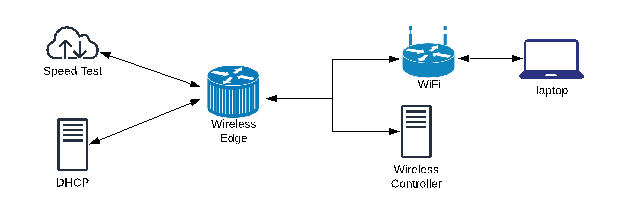
Figure 4.8 Creating an event to track a WIFI speed test requires the coordination of event data from various systems including the wireless, network address, and speed test controllers.