concept single - layer topology in category edge computing

This is an excerpt from Manning's book Making Sense of Edge Computing.
The examples in the previous section — the passenger counter and the unauthorized person detector — were both examples of a single-layer topology. To put it more formally, a single-layer topology is one in which all agents that are part of your distributed system communicate directly with one another, an example of which you can see in figure 3.7. A single set of fully connected agents is usually referred to as a region. The identity of agents is qualified by the region in which they are a member — usually in the format [region-name]-[agent-name]. Additionally, each region will assign one of its agents to become a coordinating authority referred to as a regional manager or regional controller and will usually host any administrative or dashboard systems used to control the edge-computing system.
Figure 3.7 In a single layer topology, all agents are connected and can message each other directly.
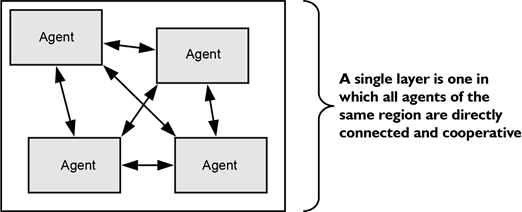
Because all agents have the ability to communicate with one another, coordinating the efforts of those agents is much simpler than if messages could only be sent to and received by certain agents. If one agent — or an edge function on one agent — needs to send a message or data to a different agent in the layer, it can do so by communicating that message or data directly to that agent. For example, in your passenger counting system, each bus can send their passenger counts directly to the agent at the central office. This central office agent can then directly provide these counts to anyone with access to the host machine, either through a database or an edge function running an interface. Let’s explore an example to see how easy it is to start up a single-layer topology.