concept relationship in category ejb
This is an excerpt from Manning's book EJB 3 in Action, Second Edition.
Entities are the Java objects that are persisted into the database. While session beans are the “verbs” of a system, entities are the “nouns.” Common examples include an Employee entity, a User entity, and an Item entity. Entities are the OO representations of the application data stored in the database. Entities survive container crashes and shutdown. The ORM metadata specifies how the object is mapped to the database. You’ll see an example of this in the next chapter. JPA entities support a full range of relational and OO capabilities, including relationships between entities, inheritance, and polymorphism.
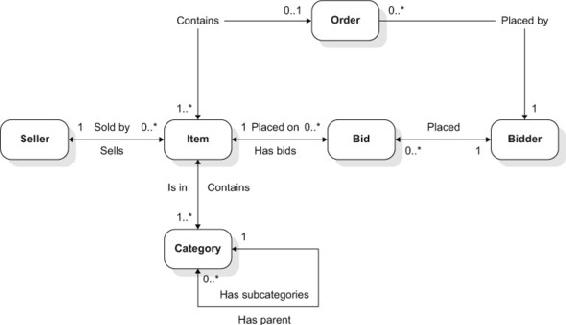
The goal of this chapter is to give an overview of the most common and often used features of JPA. First, we’ll review how to turn any domain model POJO into an entity that JPA can manage. After that, we’ll look at how to map the entity to the database tables and columns holding the data. Next, we’ll examine the various strategies JPA has for specifying and generating database primary keys. Finally, we’ll explore relationships between database tables (for example, multiple Bids on an Item) and how JPA manages mapping these relationships. Once you’ve learned how to do all of this, we’ll discuss the EntityManager in the next chapter and look at the code that actually performs all of the CRUD operations.
A domain model is a conceptual image of the problem your application is trying to solve. The domain model is made up of Java objects representing your application’s data and the relationships or associations among the data. Data may represent something physical like a customer or something conceptual like a customer preference. A relationship is a link between objects that need to know about one another. The critical thing to remember is that the domain model describes the objects and the relationships between them. The domain model doesn’t describe how your application acts on the objects—that’s the responsibility of the business rules of your EJBs and MDBs.