concept service in category ejb

This is an excerpt from Manning's book EJB 3 in Action, Second Edition.
Think of the container as an extension of the basic idea of a JVM. Just as the JVM transparently manages memory on your behalf, the container transparently provides EJB component services such as transactions, security management, remoting, and web services support. You might even think of the container as a JVM on steroids, of which the purpose is to execute EJB. In EJB 3, the container provides services applicable only to session beans and MDBs. The task of putting an EJB 3 component inside a container is called deployment. Once an EJB is successfully deployed in a container, it can be used in your applications.
In the Java world, containers aren’t limited to the realm of EJB 3. You’re probably familiar with a web container, which allows you to run web-based applications using Java technologies such as Servlets, JSP, and JSF. A Java EE container is an application server solution that supports EJB 3, a web container, and other Java EE APIs and services. Oracle WebLogic server, GlassFish server, IBM WebSphere application server, JBoss application server, and Caucho Resin are examples of Java EE containers.
Java Remote Method Invocation (RMI) is the original Java technology for exposing business services. Java RMI makes EJB possible, and beans are available by default via RMI. Java RMI is optimal in situations where the client is a Java application. RMI has much lower overhead as compared to SOAP-based web services. But if the services are to be exposed to applications written in other languages, Java RMI isn’t a suitable solution because it isn’t cross-platform. SOAP is a cross-platform solution that can be easily used from C# and C++ environments to COBOL, Python, and so on.
Another avenue for exposing services is via JMS. Although many developers probably wouldn’t associate JMS and SOAP, both technologies fundamentally focus on message exchange. Messaging middleware has a long history that predates web services. The JMS approach to messaging is asynchronous message passing using store-and-forward, whereas SOAP is focused on synchronous message invocations. SOAP provides a well-documented interface in which tools can then be used to automatically generate client code. This isn’t possible with JMS. JMS is a better solution when integrating two systems, not providing an external interface to one system.
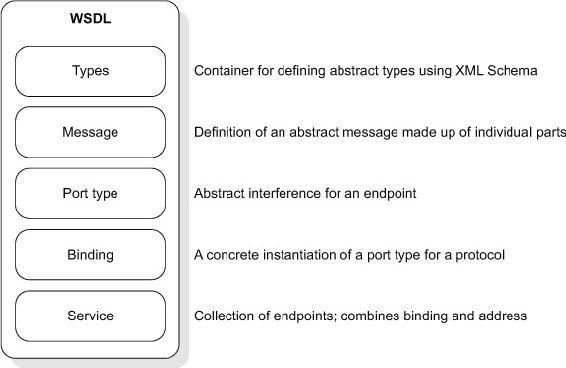
The WSDL is central to SOAP-based web services because it provides a complete blueprint of a service. It provides such a complete description of a web service that both the client and server code can be automatically generated. The code that’s generated will handle marshaling of the message and actually sending it. The structure of a WSDL file is shown in figure 8.3, and an example WSDL document for the BidService can be found later in listing 8.4.
In the types section, the data types composing the messages to be exchanged are defined. These are defined using an XML schema. The message part defines the messages that the service supports. A message is made up of one or more parts, which can serve as either input or output. The port type defines a group of operations (think interface). Each operation must have a unique name and contain a combination of input and output elements and reference the message elements. The binding section connects the port types (interfaces) with an actual protocol such as SOAP. The service section exposes the bindings as services and defines the endpoints.