concept JavaScript in category ember

This is an excerpt from Manning's book Ember.js in Action.
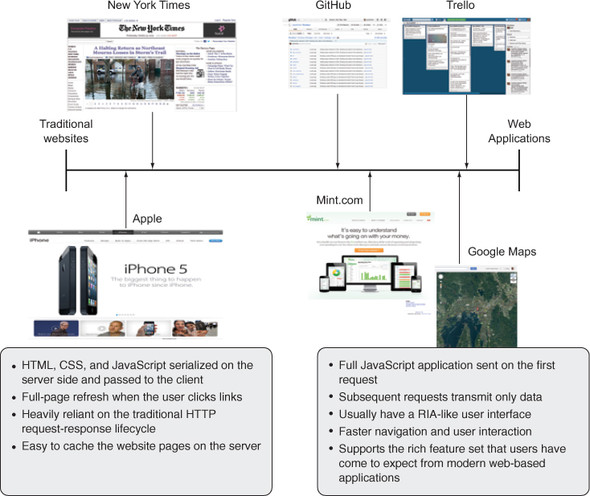
Websites that serve content based on the traditional HTTP request-response lifecycle, such as the websites for the New York Times or Apple Inc., render most of the HTML, CSS, and JavaScript on the server. As shown in figure 1.2 (at left), for each request, the server generates a new, complete copy of the website’s markup.
At the other end of the spectrum are rich internet applications (RIAs), such as Google Maps, Trello, and, to a certain degree, GitHub. These websites aim to define new application types and rival native installed applications, and they render most of their content at the client side. As shown in figure 1.2 (at right), in response to the first request, the server sends a complete application (HTML, CSS, and JavaScript) only once. Subsequent requests return only the data required to display the next page in the application.
JavaScript build tools are, sadly, still at their infancy. A range of products compete to solve the tasks of application assembly: running unit tests, performing linting (ensuring that your JavaScript code is clean), minifying source code, and packaging your application.
The problem with the existing tools is that they tend to be hard to use and give error messages that are hard to understand, even for developers. In addition, the JavaScript community has yet to agree on a standard for managing application dependency and how these dependencies should be bundled with your application. If you’re entering the JavaScript world from more-mature server-side programming languages such as Java and C#, the JavaScript build tools and the assembly pipeline leave a lot to desire.
Linting is a process that analyzes your code for common bugs and potential errors. Because JavaScript is an interpreted language, linting also involves syntax verification in the world of JavaScript applications. Figure 11.10 shows where you are in the assembly process.