concept development in category entity framework

This is an excerpt from Manning's book Entity Framework Core in Action, SE.
Since then, I’ve built new libraries that work with EF Core which I have found to significantly speed up the development of 90% of my database accesses. I work as a contract developer and these libraries, which are open-source and available to you too, automates some of the standard requirements which allows me to concentrate on the harder topics, such as understanding the client’s needs, writing custom business logic, and performance tuning where necessary. I will be talking about these libraries in later chapters.
This is an excerpt from Manning's book Entity Framework Core in Action.
Since then, I’ve built other libraries, some open source and some private, and used them on several projects. These libraries significantly speed up the development of 90% of database accesses, leaving me to concentrate on the harder topics, such as building great frontend interfaces, writing custom business logic to meet the client’s specific requirements, and performance tuning where necessary.
Over the years, I’ve built many applications, and I noticed that a large percentage (>85%) of the database queries I built needed to extract data from multiple entities, just like the book list query in chapter 2. The most efficient way to achieve this, both in performance and speed of development, was to use EF Core’s
Selectmethod to pick the exact properties from an entity class and map the related data into a DTO.
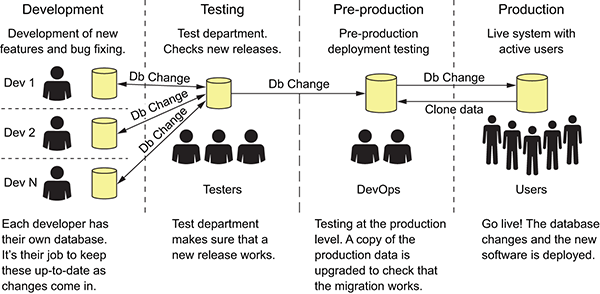
Figure 11.1 Various databases can be used in an application’s development, all of which will need database schema changes applied to them. The terms development, testing, pre-production, and production refer to different parts of the development, testing, and deployment of an application and any associated database schema changes.
This is an excerpt from Manning's book Entity Framework 4 in Action.
When you design an application, you have to decide how to access and represent data. This decision is likely the most important one you’ll make in terms of application performance and ease of development and maintainability. In every project we’ve worked on, the persistence mechanism was a relational database. Despite some attempts to introduce object databases, the relational database is still, and will be for many years, the main persistence mechanism.
OrderIT supports only a subset of the features that a real-world order-management application should. But even providing only these features will require you to use most of Entity Framework’s features. It’s important to note that some of the requirements can be handled using an object/relational mapping (O/RM) tool, but you’ll have a better experience, both in terms of simplicity of development and runtime performance, if you hand-craft SQL and execute it against the database. As you build up the example, we’ll explain when and why handmade SQL is better than using Entity Framework.