concept many - to - many relationship in category entity framework

This is an excerpt from Manning's book Entity Framework Core in Action, SE.
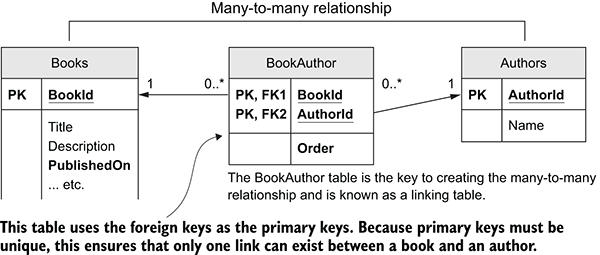
Figure 2.3 The three tables involved in creating the many-to-many relationship between the Books table and the Authors table. I use a many-to-many relationship because books can have many authors, and authors may have written many books. The extra feature needed here is the Order value, because the order in which authors are listed in a book matters, so I use the Order value to display the authors in the correct sequence

EF Core 5 has a new way to handle many-to-many relationship, which will change this section, but it isn’t released yet – see https://docs.microsoft.com/en-us/ef/core/what-is-new/ef-core-5.0/plan#many-to-many-navigation-properties-aka-skip-navigations for more information. This note will be replaced with an explanation of this new feature once it is released.
In EF Core, we talk about many-to-many relationships, but a relational database doesn’t directly implement many-to-many relationships. Instead, we’re dealing with two one-to-many relationships, as shown in figure 3.4.
This is an excerpt from Manning's book Entity Framework Core in Action.
Figure 2.3 The three tables involved in creating the many-to-many relationship between the Books table and the Authors table
3.4.4 Updating many-to-many relationships—changing a book’s authors
In EF Core, we talk about many-to-many relationships, but a relational database doesn’t directly implement many-to-many relationships. Instead, we’re dealing with two one-to-many relationships, as shown in figure 3.4.
Listing 7.1 The
Bookentity class, with the relationships at the bottompublic class Book { public int BookId { get; set; } //other scalar properties removed as not relevant… public PriceOffer Promotion { get; set; } #1 public ICollection<BookAuthor> #2 AuthorsLink { get; set; } #2 public ICollection<Review> Reviews { get; set; } #3 } #1 Link to an optional PriceOffer: one-to-zero-or-one relationship #2 Link to one side of the many-to-many relationship of authors #3 Link to any reviews for this book: one-to-many relationship

This is an excerpt from Manning's book Entity Framework 4 in Action.
Like one-to-one relationships, many-to-many relationships are one of the causes of the granularity problem that appears in the object model. The other cause of the granularity problem is covered in the next section.