concept social network in category f#

This is an excerpt from Manning's book F# Deep Dives.
Another example of an analytical component is an algorithm that analyzes social networks and tells you how to better target advertisements, or recommends people whom you might want to follow (see chapter 5).
Social networks play an important role in our society. When we look at the community of people who are using F#, Twitter plays an important role. People communicate and make interesting posts on Twitter. In this chapter, I’ll go through a basic exploratory analysis of a part of the F# community that is active on Twitter.
These factors make Twitter a good place to start with social network analysis. The nature of Twitter is open, and most of the tweets and connections are public and accessible through the API. Because people group around their shared interests, you can easily extract social networks between people.
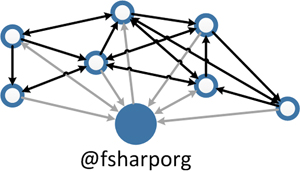
You’ll first create a network model for Twitter. A standard network is formed of nodes and links between them. The links can be either undirected or directed, with a specific orientation that’s usually shown with an arrow. You’re modeling a social network between users, so nodes in the network represent the users. Connections between them form the links. The direction of a link is important on Twitter because it represents the act of following. For this reason, you’ll use a directed network to represent the Twitter community. On the other hand, if you wanted to represent standard connections on Facebook, you’d choose an undirected network, because those friendships are symmetric and don’t have a specific orientation.
Throughout this chapter, you’ll look at part of the active F# community on Twitter. You’ll concentrate on the social network that exists around the account of the F# Software Foundation, @fsharporg (see figure 1). The foundation is an organization that promotes and advances the F# language and supports the F# community. This is a good starting point for an exploratory analysis of the F# community on Twitter. You can expect that people who follow this account are interested in F# and that most of them are actively involved in the F# online community. This network won’t include all people interested in F# on Twitter, but it probably includes a reasonable proportion of them.