concept Twitter in category f#

This is an excerpt from Manning's book F# Deep Dives.
Kit Eason is a senior software developer for Adbrain, a data intelligence company. He has developed software for automotive engineering companies, universities, energy suppliers, banks, and financial services corporations. Kit has also run many educational and training courses, including evening classes, women’s electronics classes, and CNC training for engineers. Kit is a regular speaker at Skills-Matter in London and at various conferences and meet-ups. He works mainly in F# and C# and speaks on F# and related matters. You can find him on Twitter @kitlovesfsharp and via his blog: www.kiteason.com.
Twitter is a service that allows people to share tweets: short messages of up to 140 characters. To receive messages that a specific user is sharing, you can follow the user. The act of following is asymmetric; a user can follow other users without their mutual acceptance. Followers merely express shared interests; Twitter connections don’t necessarily represent real-world friendships.
These factors make Twitter a good place to start with social network analysis. The nature of Twitter is open, and most of the tweets and connections are public and accessible through the API. Because people group around their shared interests, you can easily extract social networks between people.
You’ll first create a network model for Twitter. A standard network is formed of nodes and links between them. The links can be either undirected or directed, with a specific orientation that’s usually shown with an arrow. You’re modeling a social network between users, so nodes in the network represent the users. Connections between them form the links. The direction of a link is important on Twitter because it represents the act of following. For this reason, you’ll use a directed network to represent the Twitter community. On the other hand, if you wanted to represent standard connections on Facebook, you’d choose an undirected network, because those friendships are symmetric and don’t have a specific orientation.
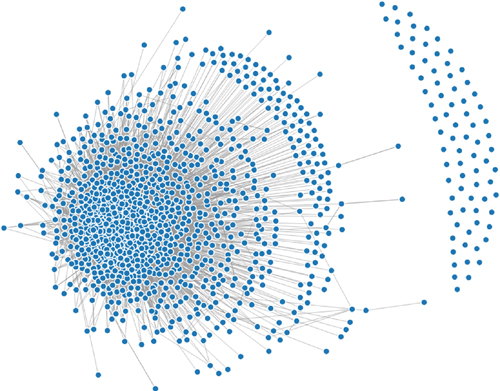
Throughout this chapter, you’ll look at part of the active F# community on Twitter. You’ll concentrate on the social network that exists around the account of the F# Software Foundation, @fsharporg (see figure 1). The foundation is an organization that promotes and advances the F# language and supports the F# community. This is a good starting point for an exploratory analysis of the F# community on Twitter. You can expect that people who follow this account are interested in F# and that most of them are actively involved in the F# online community. This network won’t include all people interested in F# on Twitter, but it probably includes a reasonable proportion of them.
The majority of the network is tightly linked together. Some nodes are isolated and not connected to the rest of the network. These nodes are either users who are connected only to @fsharporg and not to any other node in the network, or users who keep their list of followers and friends private. The core of the network is highly connected with a surrounding circle of less-connected nodes. There are no immediately visible communities in this network. If there were any communities, the graph would appear to have more than one tightly connected center. This suggests that the F# community on Twitter is homogeneous and there are no competing sub-communities that don’t talk to each other.