concept addition in category fortran
This is an excerpt from Manning's book Modern Fortran: Building efficient parallel applications.
Figure 1.4. An embarrassingly parallel problem (left) versus a nonembarrassingly parallel problem (right). In both cases, the CPUs receive input
(x1, x2)and process it to produce output(y1, y2). In an embarrassingly parallel problem,x1andx2can be processed independently of each other. Furthermore, both input and output data are local in memory to each CPU, indicated by solid arrows. In a nonembarrassingly parallel problem, input data is not always local in memory to each CPU and has to be distributed through the network, indicated by dashed arrows. In addition, there may be data interdependency between CPUs during the computation step, which requires synchronization (horizontal dashed arrow).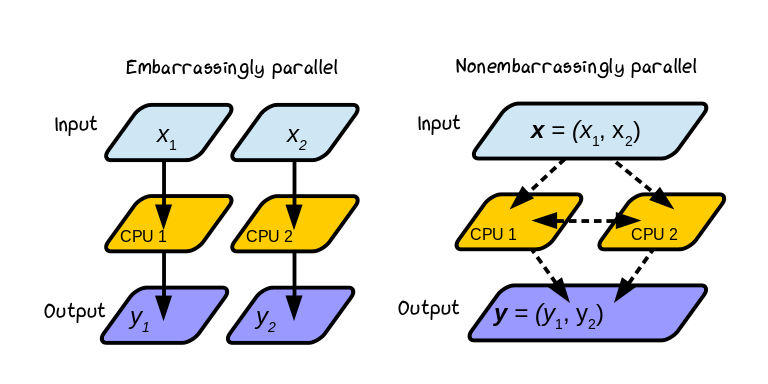
In this chapter, we’ll start by writing a simple command-line app that counts the time between now and some arbitrary date in the future, for example, your birthday. The implementation of the app is centered around a single concept-- how to apply an arithmetic operator such as addition or subtraction to a derived type. On this journey, you’ll also learn how to parse command-line arguments, validate user input, and work with dates and times. Once done, we’ll apply this knowledge to implement an almost complete arithmetic operator set for the
Fieldclass in the tsunami simulator. Besides being able to express our physics equation in an elegant way like before, we’ll also abstract away the synchronization logic in parallel execution mode by defining a custom assignment operator for theFieldclass. You’ll leave this chapter with powerful new knowledge that will allow you to extend the built-in arithmetic to arbitrary data types and beyond.