concept action in category functional programming
This is an excerpt from Manning's book Functional Programming in C++.
This is an important distinction between views and actions. A view transformation creates a lazy view over the original data, whereas an action works on an existing collection and performs its transformation eagerly.
Actions don’t have to be performed on temporaries. You can also act on lvalues by using the operator
|=, like so:std::vector<std::string> words = read_text(); words |= action::sort | action::unique; !@%STYLE%@! {"css":"{\"css\": \"font-weight: bold;\"}","target":"[[{\"line\":1,\"ch\":6},{\"line\":1,\"ch\":39}]]"} !@%STYLE%@!This combination of views and actions gives you the power to choose when you want something to be done lazily and when you want it to be done eagerly. The benefits of having this choice are that you can be lazy when you don’t expect all items in the source collection to need processing, and when items don’t need to be processed more than once; and you can be eager to calculate all elements of the resulting collection if you know they’ll be accessed often.

This is an excerpt from Manning's book Functional Programming in C#: How to write better C# code.
There’s a similar delegate family to represent actions—functions that have no return value, such as void methods:
Action represents an action with no input arguments. Action<T1> represents an action with an input argument of type T1. Action<T1, T2> and so on represent an action with several input arguments.
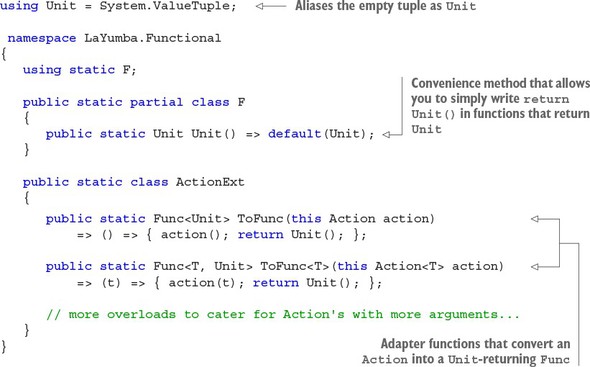
The first overload simply creates an agent with the given arguments. The second takes an action and is used to create a stateless agent: an agent that processes messages sequentially but doesn’t keep any state. (The implementation is trivial, as it just creates an ActionBlock with the given Action.) We can also define agents with an asynchronous processing function/action; I’ve omitted the overloads for brevity, but the full implementation is in the code samples. Next, we’ll get started using agents.
An actor/agent is a lightweight process featuring
- An inbox, in which messages sent to it are queued up.
- Some state, of which it has exclusive ownership.
- A processing loop, in which it processes messages sequentially, taking actions such as creating and communicating with other agents, changing its state, and performing side effects.
Agents and actors are fundamentally similar, but there are important differences:
- Actors are distributed, whereas agents are local to a single process.
- Unlike with agents, the actor model includes a model for error handling with supervisor actors that can take action if the supervised actor fails, resulting in very robust systems.