concept foldRight in category functional programming
This is an excerpt from Manning's book Functional Programming in Java: How functional techniques improve your Java programs.
But wait. Addition is a commutative operation. If you use a noncommutative operation, you must change the operation as well. If you don’t, you could end up with two different situations, depending on the types. If the operation has operands of different types, if won’t compile. On the other hand, if the operation has operands of the same types but it isn’t commutative, you’ll get a wrong result with no error. So foldLeft and foldRight have the following relationship, where operation1 and operation2 give the same results with the same operands in reverse order:
Listing 5.2 shows the common parts of the sum and product operations abstracted into a method called foldRight, taking as its parameters the list to fold, an identity element, and a higher-order function representing the operation used to fold the list. The identity element is obviously the identity for the given operation, and the function is in curried form. (See chapter 2 if you don’t remember what this means.) This function represents the operator portion of your code.
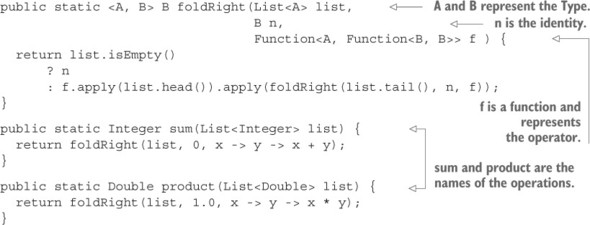
This implementation can be useful for getting a stack-safe version of foldRight:
public static <A, B> B foldRightViaFoldLeft(List<A> list, B identity, Function<A, Function<B, B>> f) { return list.reverse().foldLeft(identity, x -> y -> f.apply(y).apply(x)); }public static <A, B> B foldLeftViaFoldRight(List<A> list, B identity, Function<B, Function<A, B>> f) { return List.foldRight(list.reverse(),identity, x -> y -> f.apply(y).apply(x)); }Again, note that the foldLeft method you use is an instance method of List. In contrast, foldRight is a static method. (We’ll define an instance foldRight method soon.)