concept functional program in category functional programming
This is an excerpt from Manning's book Functional Programming in JavaScript.
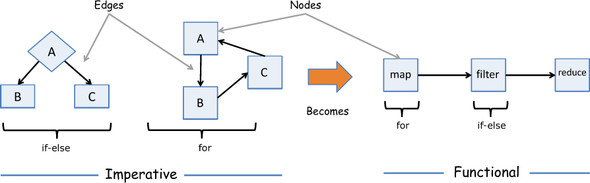
Why remove loops from your code? A loop is an imperative control structure that’s hard to reuse and difficult to plug in to other operations. In addition, it implies code that’s constantly changing or mutating in response to new iterations. You’ll learn that functional programs aim for statelessness and immutability as much as possible. Stateless code has zero chance of changing or breaking global state. To achieve this, you’ll use functions that avoid side effects and changes of state, known as pure functions.
Monads solve all the problems of traditional error handling outlined earlier when applied to functional programs. But before diving into this topic, let’s first understand a limitation in the use of functors. As you saw earlier, you can use functors to safely apply functions to values in an immutable and safe manner. But when used throughout your code, functors can easily get you into an uncomfortable situation. Consider an example of fetching a student record by SSN and then extracting its address property. For this task, you can identify two functions—findStudent and getAddress—both using functor objects to create a safe context around their returned values:
This is an excerpt from Manning's book Functional Programming in Java: How functional techniques improve your Java programs.
Functional programs are easier to reason about because they’re deterministic. One specific input will always give the same output. In many cases, you might be able to prove your program correct rather than extensively testing it and still being uncertain whether it will break under unexpected conditions. Functional programs are easier to test. Because there are no side effects, you don’t need mocks, which are generally required to isolate the programs under test from the outside. Functional programs are more modular because they’re built from functions that have only input and output; there are no side effects to handle, no exceptions to catch, no context mutation to deal with, no shared mutable state, and no concurrent modifications. Functional programming makes composition and recombination much easier. To write a functional program, you have to start by writing the various base functions you need and then combine these base functions into higher-level ones, repeating the process until you have a single function corresponding to the program you want to build. As all these functions are referentially transparent, they can then be reused to build other programs without any modifications. Functional programs are inherently thread-safe because they avoid mutation of shared state. Once again, this doesn’t mean that all data has to be immutable. Only shared data must be. But functional programmers will soon realize that immutable data is always safer, even if the mutation is not visible externally.