concept place in category functional programming
This is an excerpt from Manning's book Grokking Functional Programming.
Let’s go through our problematic examples and define which parts could be categorized as shared mutable state and caused us headaches:
This is an excerpt from Manning's book Functional Programming in C#: How to write better C# code.
If we follow the functional paradigm, we should refrain from state mutation altogether: once created, an object never changes, and variables should never be reassigned. The term mutation indicates that a value is changed in-place—updating a value stored somewhere in memory. For example, the following code creates and populates an array, and then it updates one of the array’s values in place:
int[] nums = { 1, 2, 3 };
nums[0] = 7;

nums // => [7, 2, 3]
Such updates are also called destructive updates, because the value stored prior to the update is destroyed. These should always be avoided when coding functionally. (Purely functional languages don’t allow in-place updates at all.)
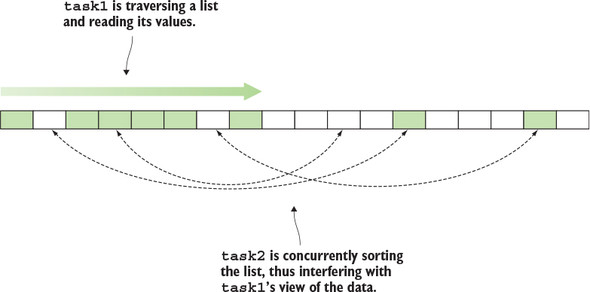
Following this principle, sorting or filtering a list should not modify the list in place but should create a new, suitably filtered or sorted list without affecting the original. Type the following into the REPL to see what happens when sorting or filtering a list using LINQ’s Where and OrderBy functions.
What if we use LINQ’s OrderBy method, instead of sorting the list in place?
Write a method that uses quicksort to sort a List<int> (return a new list, rather than sorting it in place).
This is an excerpt from Manning's book Functional Programming in Java: How functional techniques improve your Java programs.
Lambdas are used in places where a specific interface is expected. This is how Java can determine which method to call. Java doesn’t impose any constraints on naming, as may be the case in other languages. The only constraint is that the interface used must not be ambiguous, which generally means it should have only one abstract method. (In reality, it’s a bit more complex, because some methods don’t count.) Such interfaces are said to be SAM type, for single abstract method, and are called functional interfaces.
Most data structures change over time because elements are inserted and removed. Basically, there are two ways to handle such operations. The first one is update in place.
Update in place consists of changing the elements of the data structure by mutating the structure itself. It would have been considered a good idea when all programs were single threaded, although it wasn’t. It’s much worse now that all programs are multithreaded. This doesn’t only concern replacing elements. It’s the same for adding or removing, sorting, and all operations that mutate the structure. If programs are allowed to mutate data structures, these structures simply can’t be shared without sophisticated protections that are rarely done right the first time, leading to deadlock, livelock, thread starving, stale data, and all those sorts of troubles.
This is an excerpt from Manning's book Functional Programming in Scala.
Modifying a data structure in place
In the first chapter of this book, we introduced the concept of referential transparency, setting the premise for purely functional programming. We declared that pure functions can’t mutate data in place or interact with the external world. In chapter 13, we learned that this isn’t exactly true. We can write purely functional and compositional programs that describe interactions with the outside world. These programs are unaware that they can be interpreted with an evaluator that has an effect on the world.
Listing 14.1. In-place quicksort with a mutable array
def quicksort(xs: List[Int]): List[Int] = if (xs.isEmpty) xs else { val arr = xs.toArray def swap(x: Int, y: Int) = { #1 val tmp = arr(x) arr(x) = arr(y) arr(y) = tmp } def partition(n: Int, r: Int, pivot: Int) = { #2 val pivotVal = arr(pivot) swap(pivot, r) var j = n for (i <- n until r) if (arr(i) < pivotVal) { swap(i, j) j += 1 } swap(j, r) j } def qs(n: Int, r: Int): Unit = if (n < r) { #3 val pi = partition(n, r, n + (n - r) / 2) qs(n, pi - 1) qs(pi + 1, r) } qs(0, arr.length - 1) arr.toList } #1: Swaps two elements in an array #2: Partitions a portion of the array into elements less than and greater than pivot, respectively #3: Sorts a portion of the array in place