concept document in category fusion

This is an excerpt from Manning's book Fusion in Action.
Even before the internet gained popularity, the bulk of information amassed was unstructured. As humans, we typically digest information better in articles and books than we do in tables and spreadsheets. For centuries, scribes recorded, monks copied, and scholars noted. While traditional tables and schemas certainly have their uses, it is search that has made all of the information in books, letters, and documents readily available.
Full-text searching large amounts of unstructured data and text is one of the areas where search engines like Fusion really shine. Whether searching local intranet sites, enterprise content repositories, or document libraries, the principles are the same; we need the search engine to find relevant information buried in a mix of thousands or maybe millions of documents each containing a few or perhaps hundreds of pages. This is a unique problem; one that I find very interesting.
Documents are often the best way for humans to consume data. Most of us would much rather read an analyst’s summary than pore over a spreadsheet and distill the information ourselves. The challenge with documents comes in continuing to reliably find relevant data as the volume increases. Large volumes of documents represent a treasure trove of valuable data. Our job as practitioners is to enable our data consumers to get to the relevant data quickly.
An inverted index is data storage method that stores mappings of content to documents. In the case of a search engine, this would be a mapping of each word to where it is found within a document. The resulting data structure is extremely efficient for full-text searching. Take a look at Figure 3.17. You can see that the content of each document is tokenized (split into word/word-phrases) and each token is registered in the index.
Figure 3.17 An inverted index
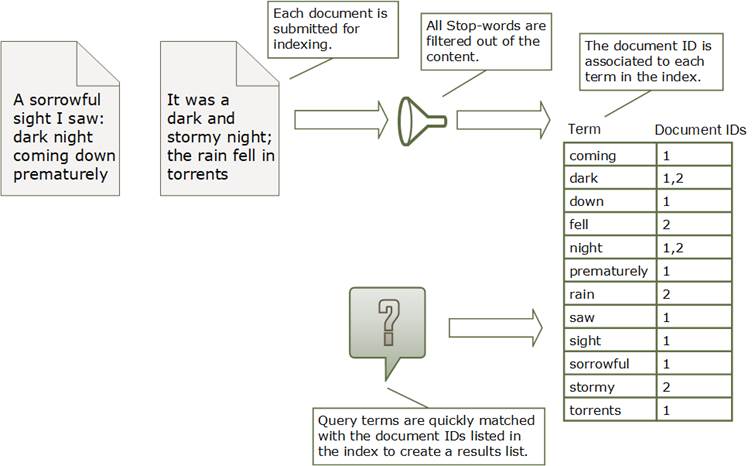
At query time, search matching is very simple. Each term in the search query is looked up in the index and the documents to which the terms are mapped are assembled to create the search results. There are many other steps involved, but a basic level, this illustrates the concept of an inverted index and how it provides such powerful and fast search performance.