concept version in category grails
appears as: version, Version, versions, versions

This is an excerpt from Manning's book Grails in Action, Second Edition.
Install a Java Development Kit (JDK) (version 1.6 or later). Run javac -version from your command prompt to verify the version you have. Most PCs come with Java preinstalled, so you may not need this step.
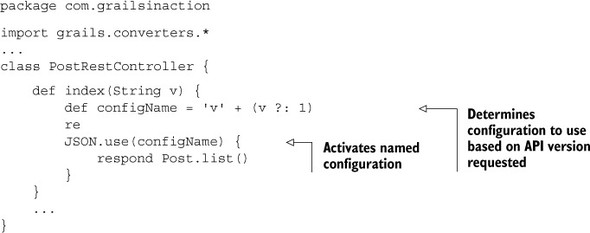
As far as we can tell, the jury is still out on what the ideal approach is. Grails has support for all three, so it’s a case of use whatever works for you. Nonetheless, you need to decide what to do for Hubbub’s API. Let’s keep it simple and rely on a URL query parameter to determine the version.
Evictions don’t happen across unrelated scopes. If the build dependencies are merged with the runtime dependencies, and each scope has a different version of a particular dependency, the resulting classpath includes both versions because eviction doesn’t happen between build and runtime. But eviction does happen between related scopes, such as compile and test, or compile and runtime. Imagine that you declare commons-compress version 1.5 as a build dependency and your runtime scope has commons-compress 1.2 through a transitive dependency. If the dependencies from both scopes are merged into a single classpath, that classpath includes both version 1.2 and version 1.5 because no eviction takes place. This raises the question of which JAR the commons-compress classes are loaded from. The answer is that it depends which JAR is first in the classpath, and there are no guarantees about what that order is. Fortunately this isn’t an issue if you use Grails 2.3. Nor is it an issue for Grails 2.2 if you add this configuration setting to your BuildConfig.groovy: grails.project.fork.run=true