concept graph database in category graphs

This is an excerpt from Manning's book Graph Powered Machine Learning.
This chapter focuses on the last three of the four steps above: store, clean, and access. The main characteristics of big data are described and the methods to handle it are discussed. Specific approaches, based on graph models and graph databases, are illustrated with all details and best practices.
Query 11.8 Cleaning up the database using APOC’s iterate procedure
CALL apoc.periodic.iterate(
"MATCH (p:Word) RETURN p",
"DETACH DELETE p", {batchSize:1000, parallel:true})

This is an excerpt from Manning's book Graph Databases in Action.
By reading this book, you have decided to take a step back from your relational database “hammer” and investigate a road less traveled: graph databases. This book is written for developers, engineers and architects who are interested in other ways to solve problems specific to working with highly connected data. We assume you are already familiar with relational databases but are interested in learning when, where, and how graph databases are a better tool.
Our goal with this book is to equip you with the techniques needed to add graph databases as another tool in your toolbelt. We like to think of this book as the guide that we wish we had when we started building graph-backed applications. Throughout this book, we’ll demonstrate common graph patterns that highlight how graph databases enable navigation and exploration of data in ways not easily accomplished with a traditional relational database.
Our primary method will be through the example of building a fictitious restaurant review and recommendation application we call DiningByFriends. As we move through the software development life cycle from planning, to analysis, to design and on to implementation, this application will demonstrate how to think about and work with graph data. Each chapter will build upon the previous chapters’ work, and by the end of this book we’ll have created a functioning application on a graph database. We believe that putting the concepts immediately to work solving a realistic set of problems, even if they are somewhat simplistic, is the best way to get comfortable using a new technology.
Let’s begin our journey with an introduction to what graphs and graph databases are, and how they compare with traditional tools such as relational databases.
Let’s take a look at what that same data looks like in a graph database, shown in Figure 1.7.
Figure 1.7 - Our order product information example shown as vertices in a graph (edges are not modeled)
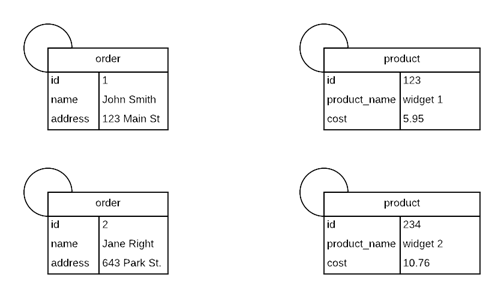
In the case above, a graph database returns these results.
gremlin> g.V().valueMap(true)
==>[label:order, address:[123 Main St], name:[John Smith], id:1]
==>[label:order, address:[234 Park St], name:[Jane Right], id:2]
==>[label:product, cost:[10.76], id:234, product_name:[widget 2]]
==>[label:product, cost:[5.95], id:123, product_name:[widget 1]]
Compared to the earlier SQL results, the results returned from the graph retains all the semantic meaning of what the object is and represents, and without the null data. With the graph database we can create much cleaner code when working with highly varied data types.

This is an excerpt from Manning's book Neo4j in Action.
Wouldn’t it be nice if you could represent the data in its natural form, making mappings more intuitive, and skipping the repeated process of “translating” the data to and from a storage engine? Thanks to graph databases, you can. Graph databases use the graph model to store data as a graph, with a structure consisting of vertices and edges, the two entities used to model any graph.
The NoSQL movement was born as an acknowledgment that new technologies were required to cope with the data changes. Neo4j, and graph databases in general, are part of the NoSQL movement, together with a lot of other, more or less related storage technologies.
With the rapid developments in the NoSQL space, its growing popularity, and a lot of different solutions and technologies to choose from, anyone new coming into the NoSQL world faces many choices when selecting the right technology. That’s why in this section we’ll try to clarify the categorization of NoSQL technologies and focus on the applicability of each category. In addition, we’ll explain the place of graph databases and Neo4j within NoSQL.