concept interest in category graphs
This is an excerpt from Manning's book Graph Powered Machine Learning.
In the model-based approach, the system builds a model from the training dataset that generalizes the training examples and is then used for making predictions. A typical example is the collaborative filtering technique for recommendation engine. Such algorithms uses user-item interactions - such as buy, view, click , etc - as training dataset to build a model. The model is then used to predict the interest of users for unseen or unbought item and promote the item with highest predicted interest.
The predictive model is a formula for estimating the unknown value of interest: the target. Such a formula could be mathematical, a query on a data structure (a database or a graph, for instance), a logical statement such as a rule, or any combination of these. It represents, in an efficient format, the result of the learning process on the training dataset and it is accessed to perform the actual prediction.
We can add preferences or interests to the model we are designing by adding nodes for users and connecting them to the features of interest. The resulting schema will look like figure 4.8.
Figure 4.8 Graph model with user interests pointing to metainformation
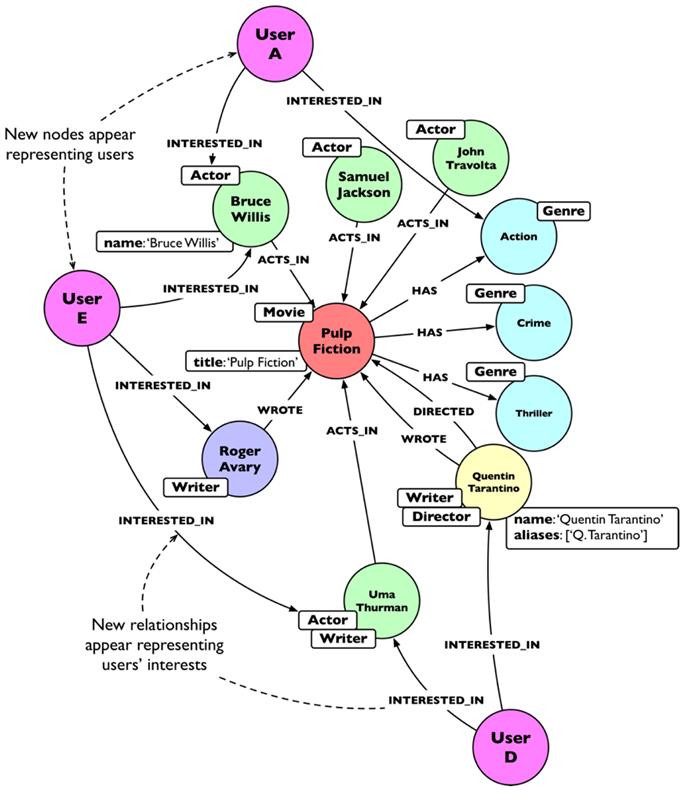
The graph model defined for modeling user preferences extends the model previously described for the items, adding a new node for each user and connecting it to the “features” of interest for the user.