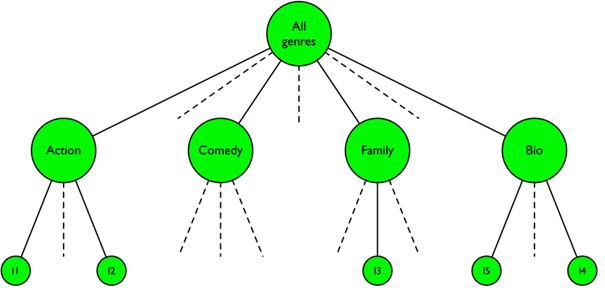
concept recommendation in category graphs
This is an excerpt from Manning's book Graph Powered Machine Learning.
There are findings in sociological and psychological disciplines that point to the relevance of a person’s social network in determining their tastes, preferences, and activities. This information is useful while building recommendation engines. One of the problems related to them is the cold start problem, which means that you can’t predict anything for a new user since you have no “purchase history” about them. Social networks and the homophily principle can be used to make a recommendation based on the tastes of connected users.
The term recommender system (RS) refers to all software tools and techniques that, by using the knowledge they can gather about the users and items in question, provide suggestions for items that are most likely of interest to a particular user [Ricci et al., 2015]. The suggestions can be related to various decision-making processes, such as what products to buy, which music to listen to, or which films to watch. In this context, item is the general term used to identify what the system recommends to users. A recommender system normally focuses on a specific type or class of items, such as books to buy, news articles to read, or hotels to book. The overall design and the techniques used to generate the recommendations are customized to provide useful and relevant suggestions for that specific type of item. Other times, it is possible to use information gathered from a class of items to provide recommendations for other types of items. For example, someone who buys suits might be interested in business books or expensive phones.
The task of providing recommendations is accomplished using queries like the following one.
Query 4.7 Query for providing recommendations to a user
MATCH (user:User)-[i:INTERESTED_IN]->(feature)-[]-(movie:Movie) #A
WHERE user.userId = <user Id> AND NOT exists((user)-[]->(movie)) #B
RETURN movie.title, count(i) as occurrences
ORDER BY occurrences desc #C