concept slave in category graphs
This is an excerpt from Manning's book Neo4j in Action.
The transactional behavior described in this chapter focuses mainly on what happens within a single instance of Neo4j. In High Availability (HA) mode, there are two types of Neo4j instances, master and slaves, and transactions ensure that writes are always consistent and durable. Although technically you can target any Neo4j instance for a write operation, writes are first pushed to the master and are eventually propagated to slaves. This behavior is automatic and can be configured to achieve a suitable trade-off between performance and durability. For more details on Neo4j HA and its use in production, see chapter 11.
Unlike typical master-slave replication setups that require all write requests to go through the master and read requests through slaves, Neo4j is able to handle write requests from any instance in the cluster. Likewise, Neo4j can process read requests from any instance, master or slave.
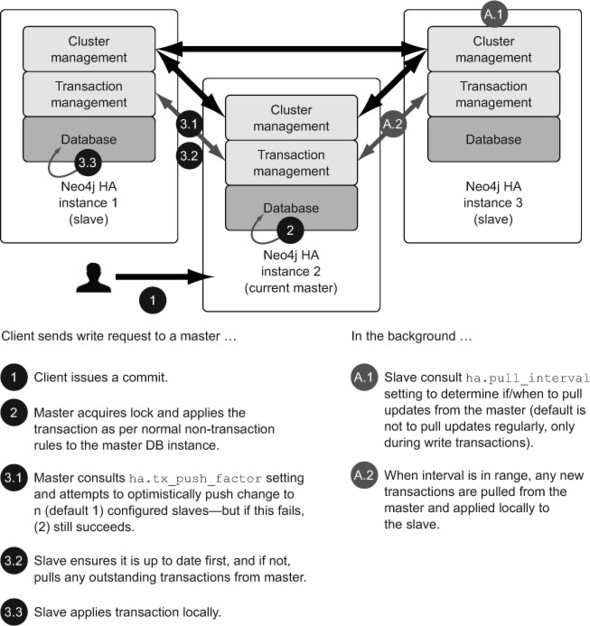
Write requests are processed quite differently depending on whether they’re received directly by the master or via a slave. Figure 11.8 shows the sequence of events that occur when a write request is sent directly to the master.
Any write requests received directly by the master will operate in much the same manner as a standard non-HA transaction does; the database acquires a lock and performs a local transaction. The only difference is that after the commit on the master has occurred, there are some configurable properties (ha.tx_push_factor and ha.tx_push_strategy) that additionally push the transaction out to n (default 1) slaves in an optimistic fashion. By optimistic, we mean that the master makes its best effort to ensure the transaction is propagated to the configured slaves, but if this propagation is unsuccessful for whatever reason, the original transaction on the master will still not fail.
Moving on to the second scenario, if a slave receives a write request, a different sequence of events takes place, as illustrated in figure 11.9.
Slave-directed writes rely on the master being available in order for the update to work. This is because the slaves will synchronously need to take out a lock on both the master and slave before it can move forward. Neo4j has reliable, built-in logic to automatically detect when instances, including masters, potentially die or can’t be reached for whatever reason. In such cases, a new master is elected, and if need be, brought up to date as much as possible. If a new master is unable to be elected for whatever reason, this essentially stops all updates to the database.
Updates are always applied on the master first, and only if this is successful are they then applied to the slave. To ensure overall consistency, Neo4j requires that a slave be up to date before any writes are performed, so as part of its internal communication protocol, Neo4j will ensure that the slave has all the latest updates applied to it before performing any local writes.
