concept step in category graphs

This is an excerpt from Manning's book Graph Databases in Action.
Modern applications are built on data; data that is ever increasing in both size and complexity. Even as the complexity of our data is increasing, so are the expectations of what insights our applications can derive from that data. If you are old enough, you likely remember when applications were primitive, took a long time to load data, and had limited features. Today’s reality is different, applications provide powerful, flexible, and immediate insight into data. But for every hundred questions these modern application answer, the most common data tool they use, namely a relational database, handles well only about eighty-eight of them. That leaves twelve types of questions where relational databases struggle. These remaining questions deal with the links and connections within the data, aspects of the data which can generate powerful and unique insights. This puts us at a crossroad: we can use the relational database “hammer” to pound away at those questions and make them work well enough, or we can take a step back and look at what other tools might answer these questions better, faster, and with less effort.
By reading this book, you have decided to take a step back from your relational database “hammer” and investigate a road less traveled: graph databases. This book is written for developers, engineers and architects who are interested in other ways to solve problems specific to working with highly connected data. We assume you are already familiar with relational databases but are interested in learning when, where, and how graph databases are a better tool.
One important difference to note about the repeat() and until() steps is that unlike the previous steps, which took a label, a string, or an integer, these steps utilize a traversal.
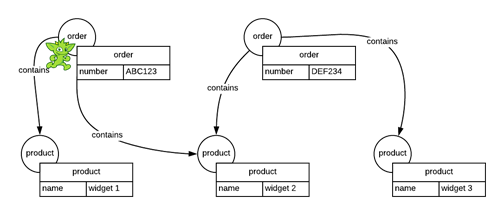
Figure 5.14 Our order product graph after step 1 with our traversers sitting on the order vertices