concept vertex in category graphx

This is an excerpt from Manning's book Spark GraphX in Action.
The word degree also has two meanings when it comes to graphs. Earlier we used it in the context of the Six Degrees of Kevin Bacon, meaning the number of hops, or edges, from one actor to another, where an edge means the two actors appeared in the same film. But the degree of a vertex is completely different: it’s the combined number of edges going out of or coming into a particular vertex. We won’t be referring to Kevin Bacon anymore, so we’ll use the word hop for those types of uses going forward, and degree only in the context of a vertex and the number of edges incident to it.
Partitioning a graph by vertices is called edge-cut because it’s the edges that are getting cut. But a graph processing system that instead employs vertex-cut, which evenly distributes the edges among the machines/nodes, more evenly balances the data across the cluster. This idea came from research in 2005, was popularized by a graph processing system called GraphLab (now called PowerGraph), and was adopted by GraphX as the default partitioning scheme.
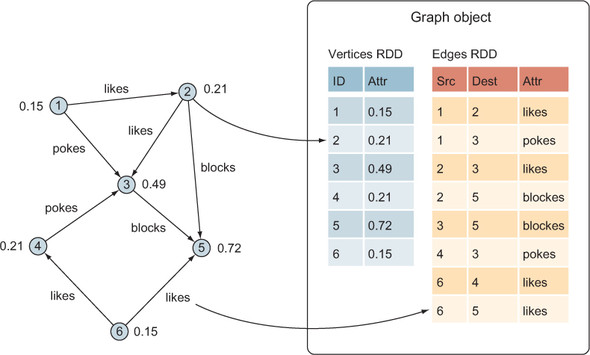
When we introduced GraphX’s subgraph() in a sidebar in section 5.2, we indicated that it would leave an isolated vertex whenever you filtered out all that vertex’s edges (see figure 8.1). That can be inconvenient. Often you know which edges you want to keep and which you want to filter out, and you don’t want to have to figure out which vertices need to stay for the edges you want to keep.