concept call in category groovy
appears as: call, call, calls, calls, The call

This is an excerpt from Manning's book Groovy in Action, Second Edition.
Although assertions may seem like an odd place to start learning a language, they’re our first port of call because you won’t understand any of the examples until you understand assertions. Groovy provides assertions with the assert keyword. The following listing makes some simple assertions.
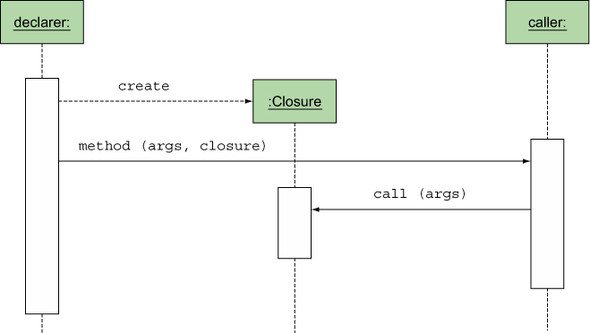
We start off by declaring pretty much the simplest possible closure—a piece of code that returns the sum of the two parameters it’s passed. Then we call the closure both directly and using the call method. Both ways of calling the closure achieve exactly the same effect.
A closure shared variable [var] has been assigned with various types and the
method [toUpperCase()] does not exist in the lowest upper bound of those
types: [java.io.Serializable <? extends java.lang.Object>]. In general, this
is a bad practice (variable reuse) because the compiler cannot determine
safely what is the type of the variable at the moment of the call in a
multithreaded context.