concept Editor in category gwt

This is an excerpt from Manning's book GWT in Action.
Editor—An object that supports the editing of zero or more properties of the domain object. Typically, it contains a number of fields known as subeditors—they implement the Editor interface. These subeditors are usually either widgets (GWT widgets implement the Editor interface) or other user-declared editors. Editor subinterfaces—The framework provides several subinterfaces of Editor, giving specific additional functionality.
By implementing the Editor interface, you signal to the framework that all fields in this particular class should be treated as subeditors. An editor could choose to provide access to its fields, but it could also prevent access to them. In order to hide fields from the framework, you use the @Ignore annotation. What happens in that case is that the framework won’t treat the field as a subeditor (and so it won’t try to flush or edit the content). There are a variety of editor interfaces to use that reside in a hierarchy of interfaces, as you can see in figure 9.5.
Figure 9.5. The editor hierarchy, with the base Editor interface on top followed by all extending subinterfaces
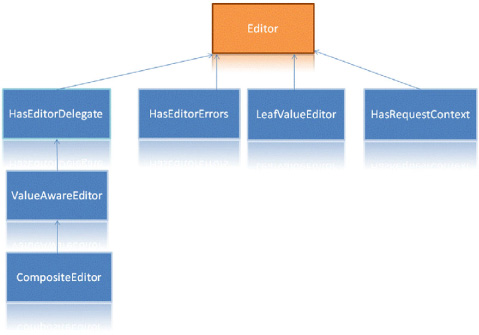
At the top level of figure 9.5 you find the base Editor interface, with all subinterfaces extending the base Editor. Which one you use depends on the nature of your editor and the complexity needed. The base Editor is for simpler use; if you need more complex behavior, you could use one of the subinterfaces (we’ll cover these sub-interfaces in section 9.6).
The Editor class can be defined initially as
public class EmployeeEditor implements Editor<Employee>{
}
This definition meets the requirements; we’ve said that it implements the Editor interface as parameterized by the domain object Employee.