concept Impala in category hadoop
This is an excerpt from Manning's book Hadoop in Practice, Second Edition.
YARN currently isn’t designed to work well with long-running processes. This has created challenges for projects such as Impala and Tez that would benefit from such a feature. Work is currently underway to bring this feature to YARN, and it’s being tracked in a JIRA ticket titled “Roll up for long-lived services in YARN,” https://issues.apache.org/jira/browse/YARN-896.
Impala is a low-latency, massively parallel query engine, modeled after Google’s Dremel paper describing a scalable and interactive query system.[5] Impala was conceived and developed out of Cloudera, which realized that using MapReduce to execute SQL wasn’t viable for a low-latency SQL environment.
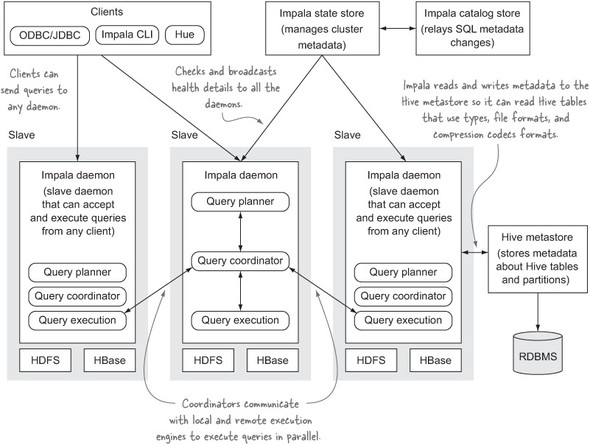
Each daemon in Impala is designed to be self-sufficient, and a client can send a query to any Impala daemon. Impala does have some metadata services, but it can continue to function even when they’re not working, as the daemon nodes talk directly to one another to execute queries. An overview of the Impala architecture can be seen in figure 9.6.
Impala allows you to query data in HDFS or HBase with a SQL syntax, so it supports access via ODBC. It uses the Hive metastore, so it can read existing Hive tables, and DDL statements executed via Impala are also reflected in Hive.
In this section I’ll present some of the differences between Impala and Hive, and we’ll also look at some basic examples of Impala in action, including how Hive UDFs can be used.
Impala supports native UDFs written in C++, which ostensibly provide improved performance over their Hive counterparts. Coverage of the native UDFs is out of scope for this book, but Cloudera has excellent online documentation that comprehensively covers native UDFs.[8] Impala also supports using Hive UDFs, which we’ll explore in the next technique.