concept JSON in category hadoop
This is an excerpt from Manning's book Hadoop in Practice, Second Edition.
$ java -jar $HIP_HOME/lib/avro-tools-1.7.4.jar
      compile  Generates Java code for the given schema.
       concat  Concatenates avro files without re-compressing.
   fragtojson  Renders a binary-encoded Avro datum as JSON.
     fromjson  Reads JSON records and writes an Avro data file.
     fromtext  Imports a text file into an avro data file.
      getmeta  Prints out the metadata of an Avro data file.
    getschema  Prints out schema of an Avro data file.
          idl  Generates a JSON schema from an Avro IDL file
       induce  Induce schema/protocol from Java class/interface
               via reflection.
   jsontofrag  Renders a JSON-encoded Avro datum as binary.
      recodec  Alters the codec of a data file.
  rpcprotocol  Output the protocol of a RPC service
   rpcreceive  Opens an RPC Server and listens for one message.
      rpcsend  Sends a single RPC message.
       tether  Run a tethered mapreduce job.
       tojson  Dumps an Avro data file as JSON, one record per line.
       totext  Converts an Avro data file to a text file.
  trevni_meta  Dumps a Trevni file's metadata as JSON.
trevni_random  Create a Trevni file filled with random instances
               of a schema.
trevni_tojson  Dumps a Trevni file as JSON.
You’ve been asked to write a MapReduce job that can take as input these large JSON files. What you have here is a problem in two parts: first, MapReduce doesn’t come with an InputFormat that works with JSON; second, how does one even go about splitting JSON?
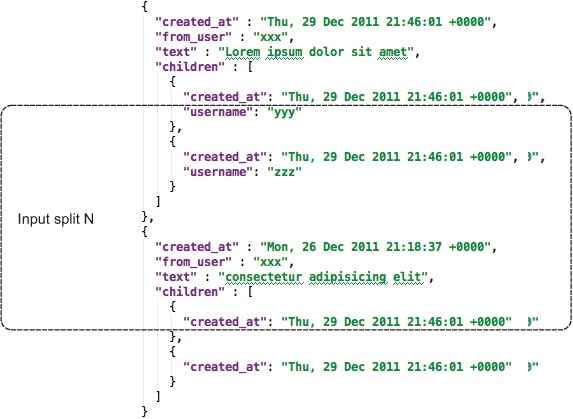
Figure 3.7 shows the problem with splitting JSON. Imagine that MapReduce created a split as shown in the figure. The map task that operates on this input split will perform a seek to the start of the input split, and then needs to determine the start of the next record. With file formats such as JSON and XML, it’s challenging to know when the next record starts due to the lack of a synchronization marker, or any other indicator that identifies the start of a record.
JSON is harder to partition into distinct segments than a format such as XML because JSON doesn’t have a token (like an end tag in XML) to denote the start or end of a record.