concept Kafka in category hadoop

This is an excerpt from Manning's book Hadoop in Practice, Second Edition.
Spark Streaming is another notable real-time data processing project developed as an extension to the Spark API, and it supports consuming data sources such as HDFS, Kafka, Flume, and more. Spark is also supported on YARN. Spark Streaming may become a strong competitor for Storm, notably because once you master Spark, you also know how to do Spark Streaming, and vice versa. This means you have a single programming paradigm for both offline and real-time data analysis.
The low-level tools in this section work well for one-off file movement activities, or when working with legacy data sources and destinations that are file-based. But moving data in this way is quickly becoming obsolete by the availability of tools such as Flume and Kafka (covered later in this chapter), which offer automated data movement pipelines.
Kafka is a much better platform for getting data from A to B (and B can be a Hadoop cluster) than the old-school “let’s copy files around!” With Kafka, you only need to pump your data into Kafka, and you have the ability to consume the data in real time (such as via Storm) or in offline/batch jobs (such as via Camus).
File-based ingestion flows are, to me at least, a relic of the past (because everybody knows how scp works :-P), and they primarily exist for legacy reasons—the upstream data sources may have existing tools to create file snapshots (such as dump tools for the database), and there’s no infrastructure to migrate or move the data into a real-time messaging system such as Kafka.
Kafka, a distributed publish-subscribe system, is quickly becoming a key part of our data pipelines thanks to its strong distributed and performance properties. It can be used for many functions, such as messaging, metrics collection, stream processing, and log aggregation. Another effective use of Kafka is as a vehicle to move data into Hadoop. This is useful in situations where you have data being produced in real time that you want to land in Hadoop.
A key reason to use Kafka is that it decouples data producers and consumers. It notably allows you to have multiple independent producers (possibly written by different development teams), and, likewise, multiple independent consumers (again possibly written by different teams). Also, consumption can be real-time/synchronous or batch/offline/asynchronous. The latter property is a big differentiator when you’re looking at other pub-sub tools like RabbitMQ.
Kafka has a handful of concepts that you’ll need to understand:
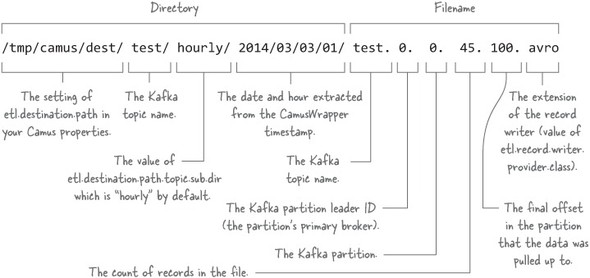
Earlier you saw the location where Camus imported the Avro data sitting in Kafka. Let’s take a closer look at the HDFS path structure, shown in figure 5.17, and see what you can do to determine the location.
The date/time part of the path is determined by the timestamp extracted from the CamusWrapper. You’ll recall from our earlier discussion that you can extract timestamps from your records in Kafka in your MessageDecoder and supply them to the CamusWrapper, which will allow your data to be partitioned by dates that are meaningful to you, as opposed to the default, which is simply the time at which the Kafka record is read in MapReduce.