concept key in category hadoop
This is an excerpt from Manning's book Hadoop in Practice, Second Edition.
If you know ahead of time which keys are high-cardinality, you can separate them out into a separate join job, as shown in figure 6.13.

This is an excerpt from Manning's book Hadoop in Action.
In order for mapping, reducing, partitioning, and shuffling (and a few others we haven’t mentioned) to seamlessly work together, we need to agree on a common structure for the data being processed. It should be flexible and powerful enough to handle most of the targeted data processing applications. MapReduce uses lists and (key/value) pairs as its main data primitives. The keys and values are often integers or strings but can also be dummy values to be ignored or complex object types. The map and reduce functions must obey the following constraint on the types of keys and values.
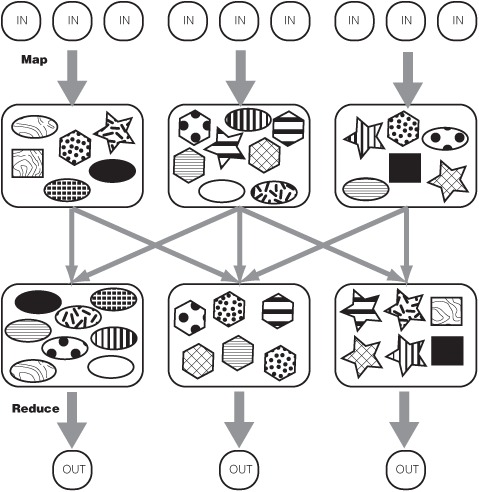
Figure 3.2. The MapReduce data flow, with an emphasis on partitioning and shuffling. Each icon is a key/value pair. The shapes represents keys, whereas the inner patterns represent values. After shuffling, all icons of the same shape (key) are in the same reducer. Different keys can go to the same reducer, as seen in the rightmost reducer. The partitioner decides which key goes where. Note that the leftmost reducer has more load due to more data under the “ellipse” key.
The way an input file is split up and read by Hadoop is defined by one of the implementations of the InputFormat interface. TextInputFormat is the default InputFormat implementation, and it’s the data format we’ve been implicitly using up to now. It’s often useful for input data that has no definite key value, when you want to get the content one line at a time. The key returned by TextInputFormat is the byte offset of each line, and we have yet to see any program that uses that key for its data processing.