concept Spark in category hadoop
This is an excerpt from Manning's book Hadoop in Practice, Second Edition.
Table 2.1. Comparison of MapReduce 1 and YARN
Capability
MapReduce 1
YARN
Execution model Only MapReduce is supported on Hadoop 1, limiting the types of activities you can perform to batch-based flows that fit within the confines of the MapReduce processing model. YARN places no restrictions on the type of work that can be executed in Hadoop; you pick which execution engines you need (whether it’s real-time processing with Spark, graph processing with Giraph, or MapReduce batch processing), and they can all be executing in parallel on the same cluster. Concurrent processes MapReduce had the notion of “slots,” which were node-specific static configurations that determined the maximum number of map and reduce processes that could run concurrently on each node. Based on where in the lifecycle a MapReduce application was, this would often lead to underutilized clusters. YARN allows for more fluid resource allocation, and the number of processes is limited only by the configured maximum amount of memory and CPU for each node. Memory limits Slots in Hadoop 1 also had a maximum limit, so typically Hadoop 1 clusters were provisioned such that the number of slots multiplied by the maximum configured memory for each slot was less than the available RAM. This often resulted in smaller than desired maximum slot memory sizes, which impeded your ability to run memory-intensive jobs.[a] Another drawback of MRv1 was that it was more difficult for memory-intensive and IO-intensive jobs to coexist on the same cluster or machines. Either you had more slots to boost the I/O jobs, or fewer slots but more RAM for RAM jobs. Once again, the static nature of these slots made it a challenge to tune clusters for mixed workloads. YARN allows applications to request resources of varying memory sizes. YARN has minimum and maximum memory limits, but because the number of slots is no longer fixed, the maximum values can be much larger to support memory-intensive workloads. YARN therefore provides a much more dynamic scheduling model that doesn’t limit the number of processes or the amount of RAM requested by a process. Scalability There were concurrency issues with the Job-Tracker, which limited the number of nodes in a Hadoop cluster to 3,000–4,000 nodes. By separating out the scheduling parts of MapReduce into YARN and making it lightweight by delegating fault tolerance to YARN applications, YARN can scale to much larger numbers than prior versions of Hadoop.[b] Execution Only a single version of MapReduce could be supported on a cluster at a time. This was problematic in large multi-tenant environments where product teams that wanted to upgrade to newer versions of MapReduce had to convince all the other users. This typically resulted in huge coordination and integration efforts and made such upgrades huge infrastructure projects. MapReduce is no longer at the core of Hadoop, and is now a YARN application running in user space. This means that you can now run different versions of MapReduce on the same cluster at the same time. This is a huge productivity gain in large multi-tenant environments, and it allows you to organizationally decouple product teams and roadmaps.
New SQL-on-Hadoop projects seem to pop up every day, but few look as promising as Spark SQL. Many believe that Spark is the future for Hadoop processing due to its simple APIs and efficient and flexible execution models, and the introduction of Spark SQL in the Spark 1.0 release only furthers the Spark toolkit.
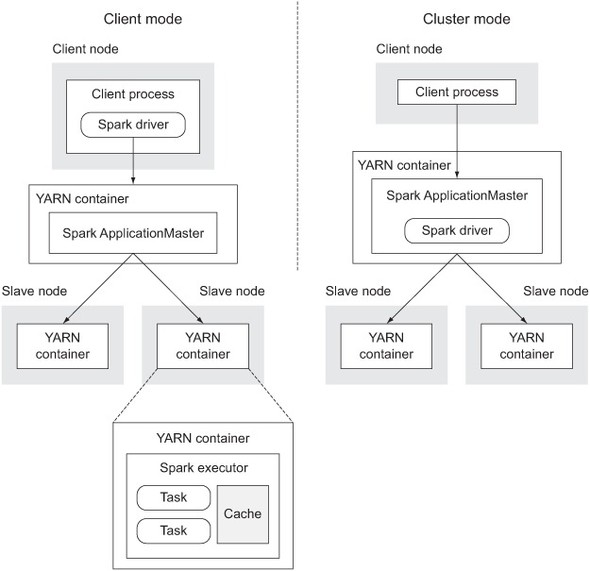
Figure 9.9 shows the architecture of Spark running on YARN.
The default installation of Spark is set up for standalone mode, so you’ll have to configure Spark to make it work with YARN.[16] The Spark scripts and tools don’t change when you’re running on YARN, so once you’ve configured Spark to use YARN, you can run the Spark shell just like you did in the previous example.