concept xml in category hibernate

This is an excerpt from Manning's book Hibernate Search in Action.
In this book, most examples will use Hibernate Annotations as the mapping metadata. Annotations have some advantages over an XML deployment descriptor: Metadata is much more compact, and mixing the class structure and the metadata greatly enhances behavior readability. Besides, modern platforms, including the Java platform, are moving away from XML as the preferred choice for code-centric metadata descriptors, which is reason enough for the authors to leave XML alone. Remember, while Hibernate Search uses annotations for its metadata, it works perfectly with hbm.xml-based domain models, and it should be simple to port the examples.
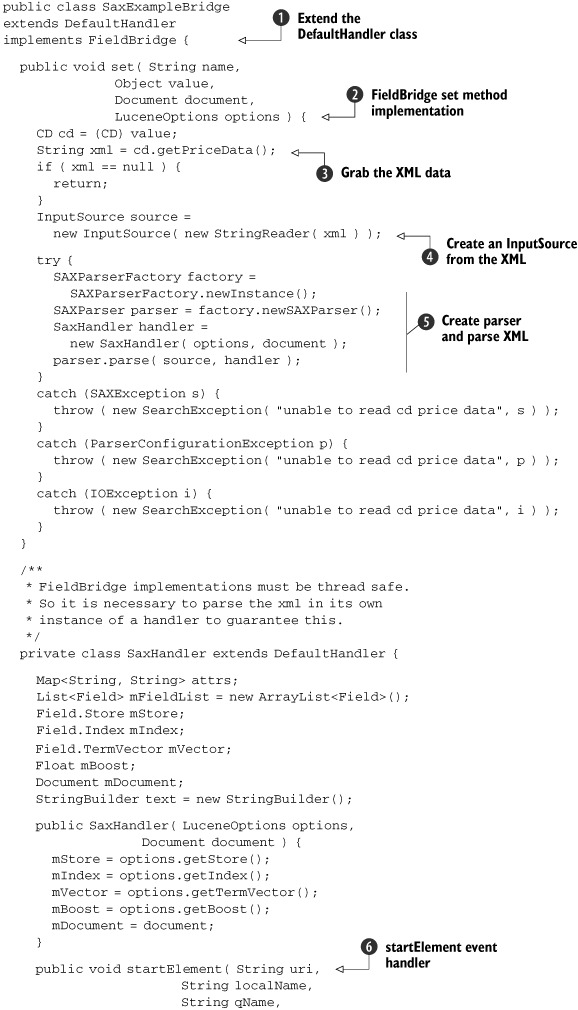
XML, the Extensible Markup Language, has become ubiquitous. There’s no getting away from it regardless of how hard you try. Quite a few Integrated Library Systems (ILS) are heavily invested in utilizing XML. Many applications’ configuration files are still formatted with it. If you really want to see just how far XML has been able to penetrate the market, search Google with the phrase “systems using xml.” We think you’ll be surprised not just at how many systems use it but also at the variety of applications.
Hibernate Search doesn’t handle XML in the way you’d normally expect. That is, it wasn’t designed to take XML documents, parse them into individual entities, and index them. It was, however, designed to parse individual entity properties containing XML and index the extracted content.