concept argument in category idris

This is an excerpt from Manning's book Type-Driven Development with Idris.
In Idris, types are a first-class language construct. Types can be manipulated, used, passed as arguments to functions, and returned from functions just like any other value, such as numbers, strings, or lists. This is a simple but powerful idea:
Modify the palindrome function so that it only returns True for strings longer than some length given as an argument. Hint: Your new function should have type Nat -> String -> Bool. You can test your answer at the REPL as follows: *ex_2> palindrome 10 "racecar" False : Bool *ex_2> palindrome 5 "racecar" True : Bool
In Idris, as you’ve seen several times now, types can be manipulated just like any other language construct. For example, they can be stored in variables, passed to functions, or constructed by functions. Furthermore, because they’re truly first-class, expressions can compute types, and types can also take any expression as an argument. You’ve seen several uses of this concept in practice, in particular the ability to store additional information about data in its type, such as the length of a vector.
In this chapter, we’ll explore more ways of taking advantage of the first-class nature of types. You’ll see how type-level functions can be used to give alternative names to types and also to calculate the type of a function from some other data. In particular, you’ll see how you can write a type-safe formatted output function, printf. For printf, the type (and even number) of arguments to the function are calculated from a format string provided as its first argument. This technique, calculating the type of some data (in this case, the arguments to printf) based on some other data (in this case, the format string) is often useful. Here are a couple of examples:
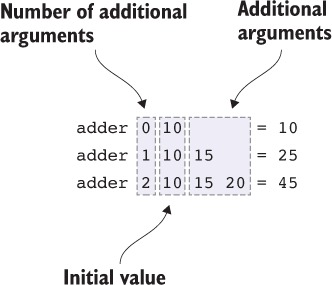
You can use type-level functions to calculate types based on some other known input. Given that function types are themselves types, this means that you can write functions with a different number of arguments depending on some other input. This is similar to some other languages that support variable-length argument lists, but with additional precision in the type because you use the value of one argument to compute the types of the others.