concept object - orient programming in category ios
This is an excerpt from Manning's book Objective-C Fundamentals.
In Objective-C the use of object-oriented programming is optional. Because Objective-C is based on a C foundation, it’s possible to use C-style functions (as evidenced by calls to NSLog in the previous chapter), but Objective-C’s full power is unlocked only if you make full use of its object-oriented extensions.

This is an excerpt from Manning's book iPhone in Action: Introduction to Web and SDK Development.
We’ll do this by focusing on three major topics. First we’ll talk about C, which is a more complex and rigorous programming language than many of the somewhat freeform web-based languages. It’s also the core of Objective-C. Then we’ll talk about object-oriented programming, which is the style of programming used by Objective-C. Finally we’ll hit on MVC, an architectural model used by many different programming languages, including Objective-C. If you’re already familiar with some of these concepts, just skip the section where the concept is described.
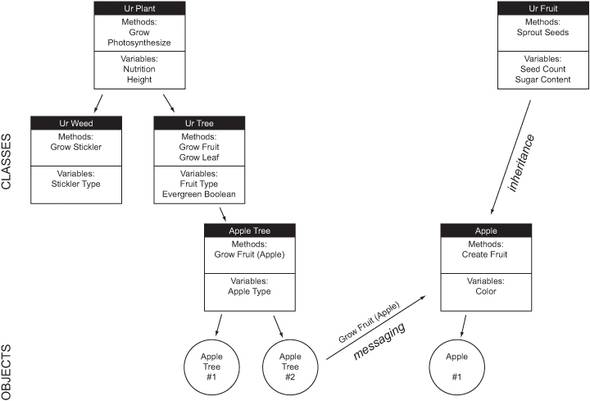
C is fundamentally a procedural language, as are early web-based languages like Perl and PHP (though that’s changing for both through current releases). You make calls to functions that do the work of your program. Object-oriented programming (OOP) moves away from this old paradigm. Specifically, there are no longer separate functions and variables; instead, data and commands are bound into a more cohesive whole.
As in our previous section, we’ve created a summary chart of the major elements of object-oriented programming, which you can find in table 9.2.
Table 9.2. Object-oriented programming introduces a number of new concepts.
OOP concept
Summary
Class
A collection of variables and functions that work together
Framework
A collection of class libraries
Inheritance
The way in which a subclass gets variables and functions from its parent
Message
A call sent to an object, telling it to execute a function
Method
A function inside a class, executed by a message
Object
A specific instance of a class
Subclass
A descendent of a class, with some features in common and some variance
If you need more information than what we’ve written here, Design Patterns: Elements of Reusable Object-Oriented Software (Addison-Wesley Professional, 1994) by Erich Gamma, Richard Helm, Ralph Johnson, and John Vlissides is an influential book that generally talks about OOP, then specifically covers some design patterns usable in it. But you should find all the basics here, starting with a look at the fundamentals of object-oriented programming.