concept memory in category isomorphic web applications

This is an excerpt from Manning's book Isomorphic Web Applications: Universal Development with React.
Another powerful server performance tool is caching. I’ve employed caching in different forms, including edge caching, in-memory caching, and saving views in a Redis (a NoSQL database) persisted cache. Each of these strategies has trade-offs, so it’s important to understand what these are and then pick the right strategy for your use case. Table 11.1 lists caching options.
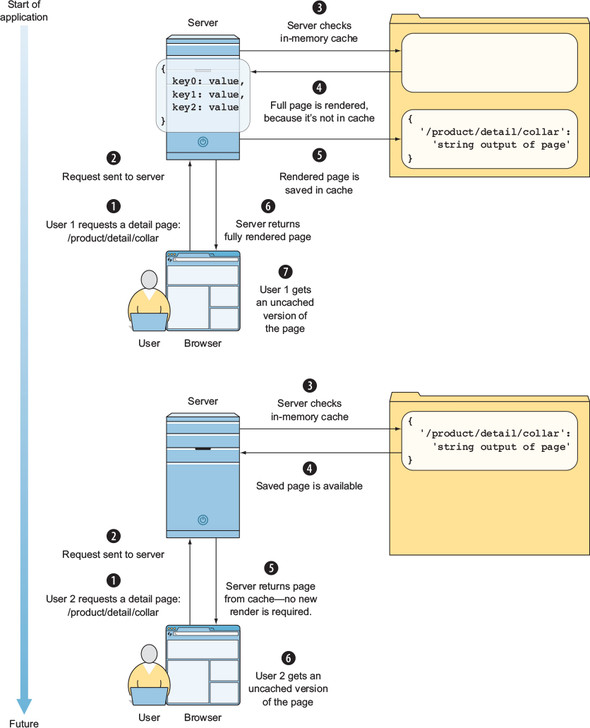
The easiest (and most naïve) solution for caching involves saving components directly in memory. For simple apps, you can achieve this by using a basic LRU cache (size-limited) and stringifying your components after they’re rendered. Figure 11.3 shows a timeline of using an in-memory cache. The first user to load a page gets a fully rendered (and slower) version of the page. This is also saved in the in-memory cache. All subsequent users get the cached version, until that page gets pushed out of the cache because the cache filled up.