concept Istio in category istio

This is an excerpt from Manning's book Istio in Action.
Istio is an open-source implementation of a service mesh. Istio was created initially by folks at Lyft, Google, and IBM but now has participants from other companies such as Red Hat, Tigera, and many others in the broader community. Istio allows us to build reliable, secure, cloud-native systems and solve for some of the difficult problems that arise like security, policy management, and observability with minimal (and in some cases, no) application code changes. Istio’s data plane is made up of service proxies based on Envoy proxy, and its control plane implements the APIs to manage and configure the proxies. The service proxies live alongside the applications and are used to effect networking behavior.
Istio is intended for microservices or SOA-style architectures, but is not limited to those. The reality is, most organizations have a lot of investment in existing applications and platforms. They’ll most likely build services architectures around their existing applications and this is where Istio really shines. With Istio we can implement these application-networking concerns without forcing changes in existing systems. Since the service proxies live outside of the application, any application for any architecture is a welcomed first class citizen in the service mesh. We’ll explore more of this in a hybrid "brownfield" application landscape.
This book will introduce you to Istio, help you understand how all of this is possible, and teach you how to use Istio to build more resilient applications that you can monitor and operate in a cloud environment. Along the way we’ll explore Istio’s design principles, explain why it’s different from past attempts to solve these problems, as well as when Istio is not the solution for your problem.
But we certainly don’t want to start using new technology just because it’s "new", "hip", or "cool". As technologists, we find ourselves easily getting excited about technology, however, we’d be doing ourselves and our organizations a disservice by not fully understanding when and when not to use a technology. Let’s spend a few moments understanding why you would use Istio, what problems it solves, what problems to avoid, and why this technology is exciting going forward.
We’re going to deploy Istio and our sample applications using containers and we’ll use the Kubernetes container platform to do that. Kubernetes is a very powerful container platform capable of scheduling and orchestrating containers over a fleet of host machines known as Kubernetes nodes. These nodes are linux machines capable of running containers, though Kubernetes handles those mechanisms. As we’ll see, Kubernetes is a great place to initially kick the tires with Istio, though we should make clear, Istio is intended to support multiple types of workloads including those running on Virtual Machines. We’ll explore how to deploy Istio on other platforms in subsequent chapters.
Listing 2.3. Verify
istioctlis able to work on your machine$ ./bin/istioctl version no running Istio pods in "istio-system" 1.7.0
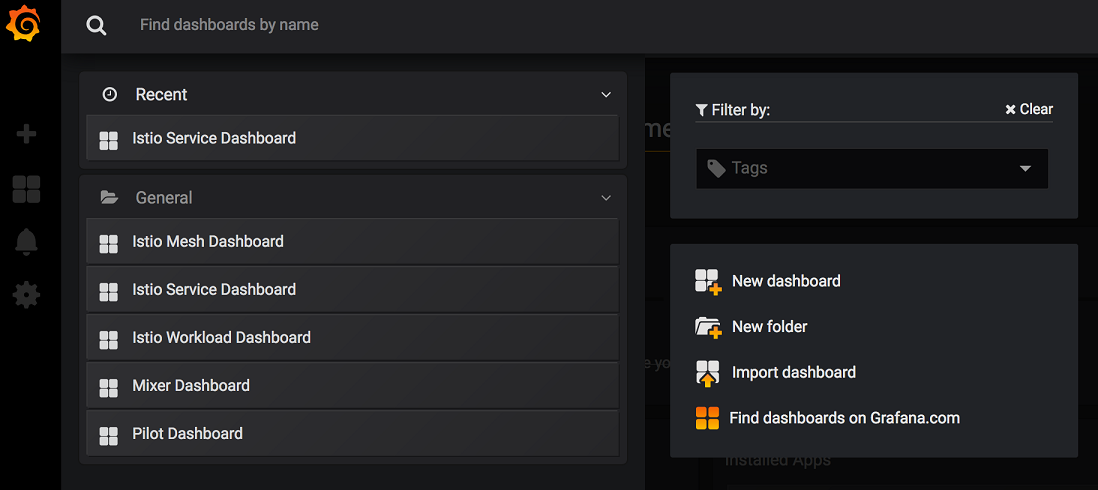
Figure 2.7. List of installed Grafana dashboards including the Istio out of the box dashboards
The dashboard should show some top-level metrics of the particular service selected. In the
Servicedropdown box toward the top of the dashboard, make sure theapigateway.istioinaction.svc.cluster.localservice is selected. It should look similar to this: