concept different encoding in category itext

This is an excerpt from Manning's book iText in Action, Second Edition.
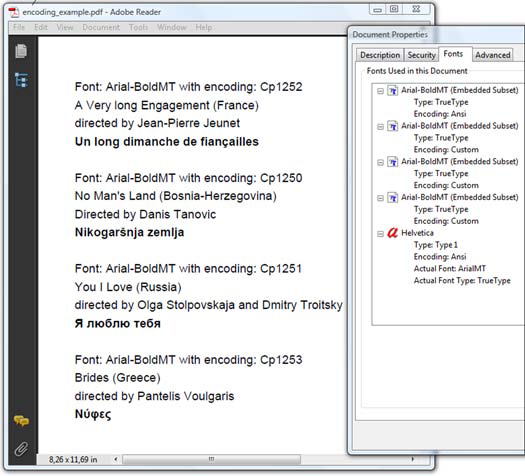
If you use a simple font, it’s up to you to decide which encoding to use. Some Western languages (for instance, French) have letters that get a cedilla (˘) or a circumflex (ˇ). Those letters are in code page 1252 (Latin 1). If you need a hacek or a caron (ˇ), you should use code page 1250 (Latin 2). Figure 11.5 shows examples using different encodings available in Arial-BoldMT, including examples in Cyrillic (code page 1251) and Greek (code page 1253).
Listing 11.4, which produced what you see in figure 11.5, shows that four different BaseFont objects were created using the same font, but with different encodings. If you look at the document properties (see the window on the right in figure 11.5), you’ll find four embedded subsets of Arial-BoldMT: one using Ansi encoding (Cp1252) and three using a custom encoding.