concept signature in category itext

This is an excerpt from Manning's book iText in Action, Second Edition.
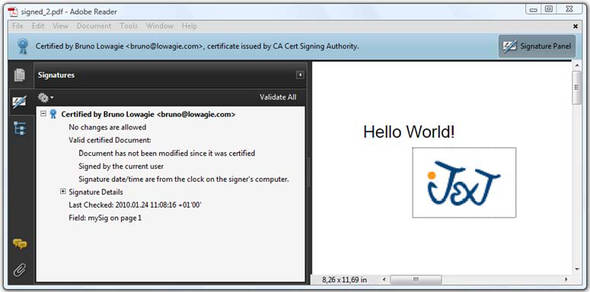
Listing 12.14 adds a signature to the field created in listing 12.13. There are two options: with the parameter certified, you can choose whether or not to use a certification signature. In figure 12.5 there’s a bar with the text “Certified by Bruno Lowagie <bruno@lowagie.com>, certificate issued by CA Cert Signing Authority.” This is different from what was displayed in figure 12.4, where it only said “Signed and all signatures are valid.”
There’s also a graphic parameter to define whether or not to use a graphical object instead of a text message. In figure 12.5, the 1T3XT logo was used to visualize the signature on the page.
The signature shown in figure 12.4 is an ordinary signature, aka an approval or a recipient signature. A document can be signed for approval by one or more recipients.
The signature shown in figure 12.5 is a certification signature, aka an author signature. There can only be one certification signature in a document. In iText, you create a certification signature by using the setCertificationLevel() method
with one of the following values:
You can check whether the signature covers the whole document by using the signatureCoversWholeDocument() method. This is true for the second signature, but the first signature only covers revision 1 of 2, and that’s not the complete document.
You can get the revision number for the signature with the getRevision() method, and the total number of revisions with getTotalRevisions(). The verification of the signature is done with the PdfPKCS7 object. This object can give you the public certificate of the signer and its parent certificates, as well as the signing date. You can use the verify() method to find out if the document was tampered with, and the verifyCertificates() method to check the certificates in the PDF against the certificates in the cacerts key store. In this example, you didn’t pass any CRLs, so the third parameter of the method is null.